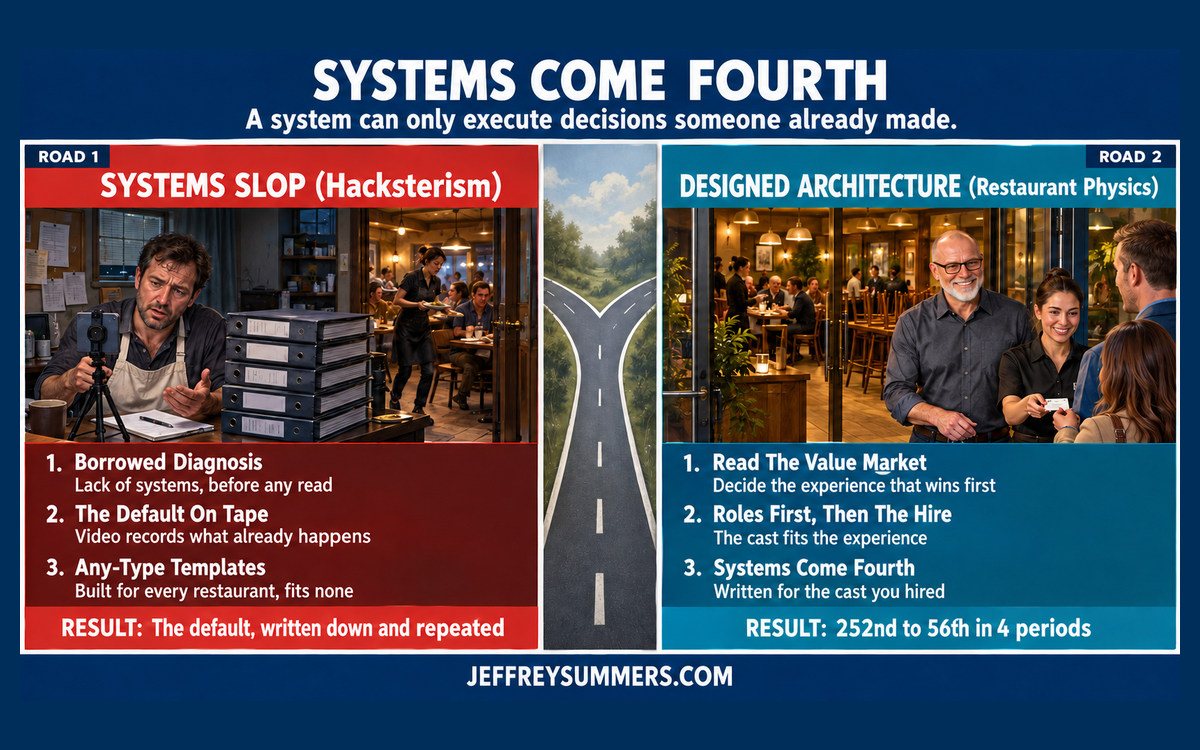

A discount is a payment made in place of knowing the Guest — and the relationship it is billed to build never compounds, because a payment is not a relationship.
Every message a restaurant sends makes one of two claims: I know you, or I’ll pay you. The promotional toolkit — discounts, offers, limited-time novelties, blasts — reaches for the second because the first requires a mechanism it doesn’t have: listening. The levers move behavior by paying for it, the metrics report that the levers were pulled, and the compounding follows the road the lever is actually on. That is the [Two Roads] of my framework run through the marketing function. This quarter put the case on the record: a survey claim that 62% of consumers will happily pay premiums for novelty, a loyalty program the Guest uses like a coupon, and a chain that posted 9.5% traffic growth in the same macro.
The Claim That Circulates
The strongest evidence is the claim itself, taken apart. As it circulates through industry marketing: 62% of consumers will happily pay a premium for novel menu items. The finding is Datassential’s, as reported: more than 60% of fast casual diners are willing to pay a premium or select items featuring unique and innovative options. Three things changed on the way into the marketing. Fast casual diners became all consumers. “Or select” became “pay more.” And an either/or became “happily” — a feeling the survey never measured. The rest of Datassential’s own value research marks the boundary the circulating claim erases: 64% of consumers want a good deal that doesn’t cost them food quality or experience, only 21% will pay more for a great meal, and in the tested experiment, Caesar purchase interest started at 40% at $10.99, rose to 44% when grilled chicken could be added for four dollars more, and fell to 35% when the price reached $18.99. The willingness to pay is real, narrow, and conditional. The circulating claim is a transactional lever — pay more for novelty — dressed in a feeling the data doesn’t contain. The word “happily” is doing all the work the numbers wouldn’t.
What The Guest Does With The Program
The second specimen is the loyalty program, and the Guest’s own behavior reads it. Popmenu’s 2026 survey of 3,000 consumers found 67% spending less than the year before, and the tactics they report are the periphery of the check: water instead of drinks, pickup instead of delivery, appetizers instead of entrees. Forty-eight percent named coupons and loyalty programs among those tactics. The survey groups the two, and that grouping is the finding: the Guest reaches for the loyalty program at the same moment she reaches for a coupon — to cut the check. That use does not tell you what any individual program is capable of. It tells you what the relationship is, as she experiences it: a discount relationship. She is telling the operator what the relationship is made of, and the operator is reading it as engagement.
What A Discount Actually Says
A discount is a broadcast. It says “I’ll pay you,” which is the opposite of “I know you” — one is a claim that requires only money, the other is a claim that requires listening to verify. And the promotional toolkit has no listening mechanism in it: no way to hear a Guest’s condition, no way to remember her, no place for what she said last time to matter this time. Marketing counts broadcasts as conversations because the toolkit measures sends, opens and clicks — the vocabulary of reaching people, not knowing them.
This is why the levers compound the wrong way. The [Discount Traffic Myth] is the single most expensive false belief in the industry: the apparent lift is deal-shoppers converting to the discount, not the brand. The reference price resets to the deal, and when the deal ends, the traffic ends with it. Every discount locks in the next one — [Transactional Contraction] — because the reversal is not a lever anymore. It is a rebuilding project, and it has to defeat the expectations the discounts trained the Guest to hold.
The Quarter That Did Not Need The Levers
The boundary case ran in the same macro that produced the trim data. Cheesecake Factory’s third quarter: comparable sales up 15.2%, built from 2.4% pricing, 3.3% mix and 9.5% traffic — 940 basis points above the Black Box Casual Dining Index — in the quarter the company’s president called “typically our slowest quarter of the year” and its CFO called “historically the slowest quarter of the year for the restaurant industry.” The company’s own attribution put the result on its operators: “our best-in-class operators and their ability to consistently execute at a high level.” Nothing in the release attributes the traffic to a promotion. Read through my framework, the two results are one verdict from two populations: where the visit covers the money, the check takes care of itself; where it doesn’t, the Guest executes the trim. The relational grounding is produced on the stage, by a cast that stays long enough to know the Guests. Marketing can point at it — and at its best, pointing is the whole job.
The Missing Cast
Notice who is missing from the retelling. The company credited its operators; the market’s version credited the menu, the rewards program and a viral video, and in neither telling does the cast appear as people who know the Guests — only as a mechanism that executes. That is the pattern wherever the levers get the credit: the people holding the actual relationship are erased from the mechanism. It is not a reporting accident. A marketing function that cannot hear the Guest cannot hear the cast either, and the story it tells will always be about itself.
The Diagnostic
Run the stranger test. Pull your last month of Guest communications — emails, texts, app pushes. Strike everything that could have been sent to a Guest who has never visited. What remains is the part of your relationship that knows her.
The operation is either the whole relationship or the thing the relationship forgives — and every message you send runs the same fork. It either knows the Guest or it pays her. The first builds a business that compounds. The second rents one. I know you, or I’ll pay you. One is a business. The other is a lease.
What You Do Monday Morning
Take one preference a Guest has actually communicated — a table, a drink, an anniversary, a dislike. Trace it: was it retained anywhere, did it reach the cast member who could act on it, did it change the next interaction? Repair the first broken handoff. That is a listening mechanism, and it is the only thing in the building that can make the next message true.
Digging Deeper
Positions on the record:
- The Restaurant That Never Needed Forgiving
- The Turnaround That Needs A Turnaround
- Why I Don’t Sell Restaurant Turnarounds
Terms used in this piece: Two Roads, Discount Traffic Myth, Transactional Contraction. Definitions in the Knowledge Base.
Sources Cited In This Piece
Datassential Foodsurveys, Bundled Meals Earn the Right to Upcharge, reporting Datassential’s State of Value research — 64% want a good deal that doesn’t cost them food quality or experience, 21% will pay more for a great meal; Caesar purchase interest 40% at $10.99, 44% with +$4 grilled chicken, 35% at $18.99 — https://foodsurveys.datassential.com/post/bundled-meals-earn-the-right-to-upcharge
Fast Casual, reporting Datassential on the fast casual sector — more than 60% of fast casual diners willing to pay a premium or select items featuring unique or innovative options — https://www.fastcasual.com/blogs/report-fast-casual-sector-still-outpacing-overall-restaurant-growth/
Fast Casual, reporting Popmenu’s survey of 3,000 US consumers, February–July 2026 — 67% spending less year over year; 48% using coupons and loyalty programs among check-trim tactics — https://www.fastcasual.com/news/7-ways-diners-are-cutting-the-check-from-skipping-drinks-to-choosing-carryout/
The Cheesecake Factory Incorporated, third quarter fiscal 2026 earnings call, October 27, 2026 — comparable sales +15.2% from 2.4% pricing, 3.3% mix and 9.5% traffic; 940 basis points above the Black Box Casual Dining Index; David Gordon: “typically our slowest quarter of the year”; Matt Clark: “historically the slowest quarter of the year for the restaurant industry”; David Gordon: “our best-in-class operators and their ability to consistently execute at a high level” — https://stockanalysis.com/stocks/cake/transcripts/717302-q3-2026/
Anchorage Daily News, October 27, 2026 — market coverage crediting the menu, the rewards program and a viral video for the quarter — https://www.adn.com/business-economy/2026/10/27/joking-aside-the-cheesecake-factory-is-seeing-pretty-good-business
Discover more from Hacksterism
Subscribe to get the latest posts sent to your email.