
From the Idea to the Triage
Margin can’t be protected after the doors open, because the design set it before the first Guest walked in, and every daily prime cost check is the operator reading a score that was decided months earlier.
MarginEdge’s October newsletter, The Board, opens on a hard number: a third of operators told the National Restaurant Association they weren’t profitable in the first half of the year. Its answer, under the heading of protecting your margin, is to check prime cost every day, set two or three alerts, spend 15 minutes on it before the lunch rush, and re-cost the holiday menu. Every move in it happens after opening. None of it touches the board, the market read, the site, the lease, the build, the menu’s design or the model, which is where margin gets set. That is [Lagging As Leading]: a lagging number sold as a lever. It costs the operator the one thing a daily report can’t give back, which is the margin the design never left room for. For the third of operators who aren’t profitable, what’s at stake is whether they keep fixing the score or go back and fix what produced it.
Their Own Words Make The Case
The newsletter makes the argument against itself. Most operators, it says, “don’t see their prime cost until weeks after the period closes, which is like checking the score after the game is over.” The fix it offers is to check the score every morning instead of every month. A score checked daily is still a score. It tells you sooner what already happened, but it doesn’t make the play.
Then the line that gives it away: “Monthly is too slow for the number that decides whether you make money.” Prime cost doesn’t decide whether you make money. The rent, the seat count, the layout, the menu and the price structure decided it, and prime cost reports how those decisions are playing out. Treat the report as the decision and you’ve put the steering wheel in the rearview mirror.
None of this means the daily number is useless. A running read beats a stale one, and an operator with a designed model should read his numbers against it every shift. The fault isn’t the tool. The fault is the claim that the tool protects margin. Monitoring catches margin leaking out. It can’t create margin the design never put there.
Why A Vendor Puts Margin Downstream
A company that sells monitoring will always place margin control downstream, because downstream is where its product works. That isn’t a conspiracy. It’s the shape of the market. The newsletter closes on an invitation to a live product demo, and the whole edition is built to bring the operator to it. The prescription fits the product, not the problem.
The operator who reads it gets the vendor’s view of the business: the restaurant as a stream of invoices, sales and labor hours to be watched. Nothing in that view asks how the restaurant was designed, because the product has nothing to say about it.
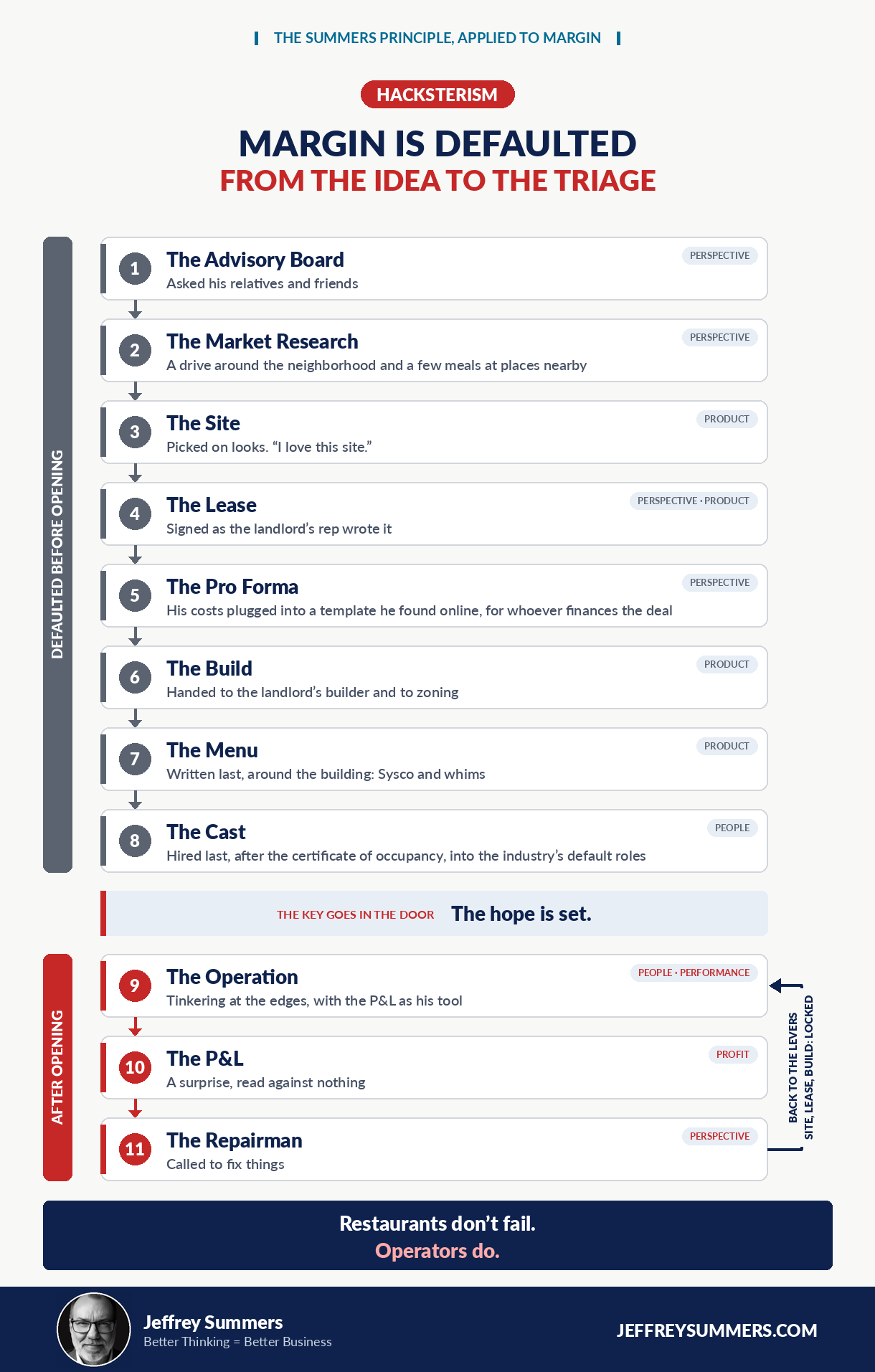
Perspective: The Plan That Was Never Made
The default operator’s restaurant begins as an idea and a hope. His advisory board is his relatives and friends. His market research is a drive around the neighborhood and a few meals at places nearby. His pro forma is his costs plugged into a template he found online, built for whoever finances the deal rather than to test whether the deal works. The lease is signed as the landlord’s rep wrote it, and it’s often signed pending financing, before anything has proved it can carry the rent.
That’s the default Perspective: the decisions that set margin made on instinct, by people with no stake in the result, against no model. When the money runs short, he calls the repairman to fix things. By then the levers that set margin are locked, because the site, the lease and the build can’t be undone.
Product: Built Around The Building
The site was picked on looks. “I love this site.” The build was handed to the landlord’s builder and to zoning. Then the menu was written last, around a building that already existed: Sysco and whims.
In my framework, the menu is engineered and the experience is designed or defaulted. The newsletter’s menu advice is to re-cost against your latest invoices and run “a quarterly check on your stars, plowhorses, puzzles and dogs.” That’s menu engineering run backward, as an audit of a menu nobody engineered. The re-cost tells the operator his potato-heavy sides got pricier. It can’t tell him that a menu written around the wrong kitchen, priced without the [X Factor], was never going to hold its margin at any potato price.
People: Hired Last, Into Default Roles
The default operator hires last, after the certificate of occupancy, and he hires people into the industry’s default roles rather than into roles the model designed. There is no Team assembled first to hire and train the cast. The GM shows up to run a building he had no part in planning. The Culinary Lead(s) inherit a kitchen and a menu built without them.
When labor runs 2 points over target, the newsletter’s alert fires. What the alert can’t see is that the labor model was never designed. The schedule, the roles and the coverage were defaulted from industry habit, so the alert fires on the symptom of a decision nobody made.
Performance: Tinkering At The Edges
Once the hope is set and the doors open, the default operator runs the restaurant by tinkering at the edges, with the P&L as his tool. That’s exactly what the newsletter prescribes: watch the number, flag the drift, chase the produce order that landed early, trim the overstaffed slow shift.
The edges matter. Done well, they maximize the margin potential the design created. But they work inside the limits the design set. An operator can cut a point of food cost with tighter ordering. He can’t cut his way out of an occupancy cost the model never tested, a seat count that can’t produce the volume, or a price structure that never covered the rent. Fifteen minutes before the lunch rush is the right habit for a designed restaurant. For a defaulted one, it’s triage.
The Closer
The third of operators who weren’t profitable didn’t lose their margin in the first half of the year. They never had it. It was defaulted at the board, the drive-around, the site, the lease, the pro forma, the build, the menu and the hire, and the P&L reported the result: a surprise, read against nothing. Profit is the scorecard, not the tool. Watching it daily doesn’t change what it reports. It only shortens the wait to find out. The default plan runs from the idea to the triage, and it assumes the triage will happen. Restaurants don’t fail. Operators do.
What You Do Monday Morning
Pull the pro forma you gave whoever financed the deal and last period’s P&L. Put them side by side, line by line. Every line where they don’t match is a decision somebody made or defaulted, and no daily report will close it. Find the biggest gap and trace it back to the decision that made it. That’s the one to go back to.
To understand the ideal state, go to Restaurant Physics: Margin Is Engineered.
Digging Deeper
Positions on the record
- Margin Is Engineered — https://physics.jeffreysummers.com/margin-is-engineered/
- The Insanity of Losses — https://hacksterism.jeffreysummers.com/the-insanity-of-losses-2/
- Restaurants Don’t Fail, Operators Do — https://physics.jeffreysummers.com/restaurants-dont-fail-operators-do-2/
- Margin Is Built, Not Found — https://physics.jeffreysummers.com/margin-is-built-not-found/
- Every Input That Moves Your Margin Has An Owner — https://physics.jeffreysummers.com/every-input-that-moves-your-margin-has-an-owner/
- I Get Two Kinds Of Calls — https://physics.jeffreysummers.com/i-get-two-kinds-of-calls-2/
- Your Lease Is A Profit Decision — https://kb.jeffreysummers.com/docs/5-x-your-lease-is-a-profit-decision/
- Profitable By Design — https://kb.jeffreysummers.com/docs/5-x-profitable-by-design/
- Build Your Team Before You Build Your Restaurant — https://kb.jeffreysummers.com/docs/5-x-build-your-team-before-you-build-your-restaurant/
Terms used in this piece: Lagging As Leading, X Factor, Summers Principle, Repair Work. Definitions in the Knowledge Base.
Sources Cited In This Piece
MarginEdge, The Board: October 2026, 10.16.2026 — a third of operators told the National Restaurant Association they weren’t profitable in the first half of the year; prime cost “eats up 55% to 65% of every sales dollar”; “checking the score after the game is over”; the 32% food cost and 2-point labor alerts; “Spend 15 minutes on it before the lunch rush”; “Monthly is too slow for the number that decides whether you make money”; “Re-cost your holiday menu now”; the quarterly check on stars, plowhorses, puzzles and dogs; the invitation to the November 5 product demo — https://www.marginedge.com/blog/the-board-october-2026
Discover more from Hacksterism
Subscribe to get the latest posts sent to your email.