
True Food Kitchen Mortgaged Tomorrow And Never Bought The Fix
The Verdict
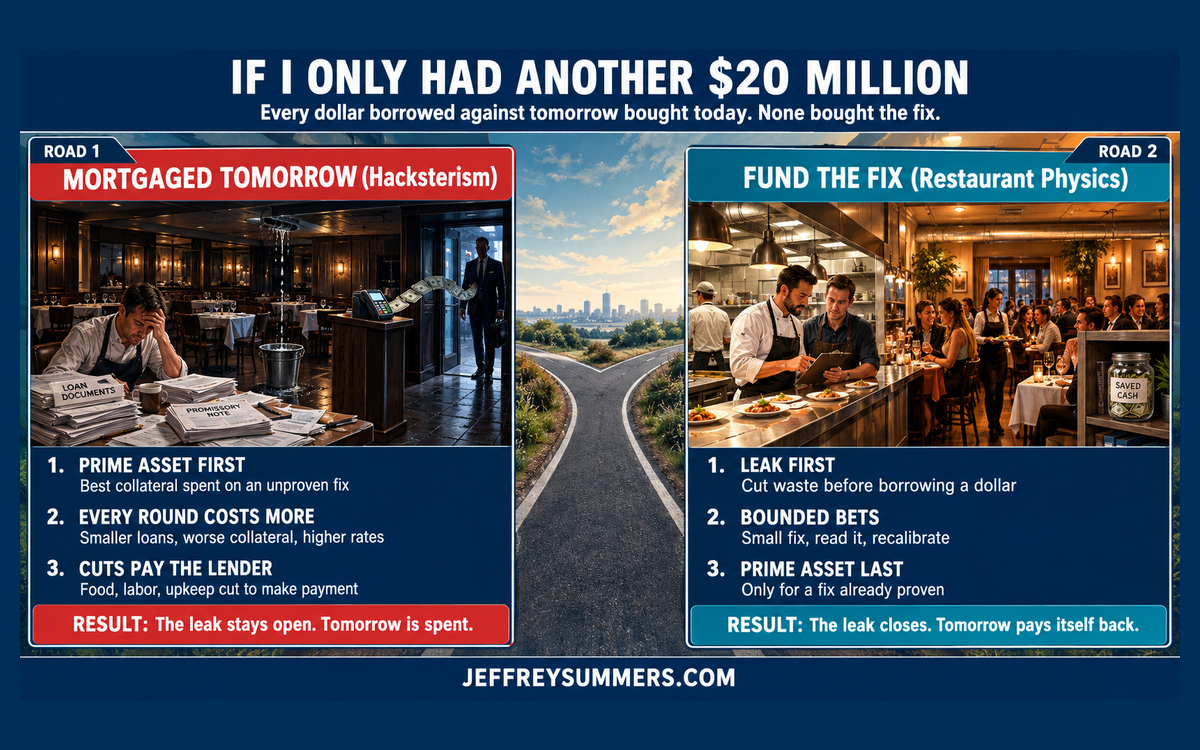
True Food Kitchen did not run out of money. It ran out of tomorrow to mortgage, because every dollar it borrowed against tomorrow bought today and not one of them bought the fix.
That is [Mortgaged Tomorrow]: the operation spends tomorrow’s cash on today without buying a fix to the leak that created the need, so tomorrow inherits the obligation and the leak together. True Food ran it for four years, from a more than $100 million equity round in September 2022 to a $20 million bankruptcy loan from its largest shareholder on October 2, 2026. In between it borrowed from its own owners at 15 percent, sold its future delivery receipts, pledged its card receipts, and sold $7.2 million of meals to diners in advance. It came into court with $1.6 million of unrestricted cash, which its own filing says would have lasted about two weeks. Twelve restaurants closed the same day. Thirty-four remain.
The coverage this week called it a cost problem. The company’s own sworn declaration does not.
The Sequence, In The Company’s Own Paper
Every figure below is from the first day filings in the Southern District of Texas, Case No. 26-90806: the declaration of Nathan Cook, the chief restructuring officer, and the motion for debtor-in-possession financing.
September 2022. More than $100 million of equity, led by HumanCo and Manna Tree, into a 42-unit brand, to grow the network and develop smaller-footprint restaurants. This is the highest and best thing the company had to mortgage: the brand’s story, sold as ownership.
By the fall of 2026 the chain had 46 locations. Four more, net, four years after the largest raise in its history.
July 2025. Convertible notes to HumanCo and Manna Tree, $10.0 million of original principal at 15 percent, interest capitalized quarterly. Unsecured as issued. $11.3 million outstanding by September 29, 2026.
The multi-draw loan from Kingswood Partners and Manna Tree’s vehicle, MTN C203, at 15 percent. The lenders elected to take interest in kind, which means no cash interest was paid. It was added to the balance. Senior liens on substantially all assets.
The future sales. $2.2 million owed to Parafin, DoorDash Capital, which asserts an interest in future delivery receivables. $1.65 million owed to Rewards Network under a facility secured by property, accounts and receivables. $7,186,617 owed to inKind, which advances cash in exchange for dining credit it sells to diners and is repaid as those diners eat. The owners’ own senior loan permitted up to $22.5 million of these arrangements.
August 27, 2026, 38 days before the filing. Three things in one day. $5.0 million of new advances on the multi-draw loan. The borrowers acknowledged $1,989,041 of interest accrued and unpaid. And the owners’ convertible notes were amended from unsecured to secured, with liens on substantially all assets.
October 2, 2026. The bankruptcy loan. $20 million from HumanCo TFK IV, an affiliate of the largest shareholder, at 10 percent paid in kind, a 3 percent commitment fee on the full $20 million, a 3 percent funding fee on every advance, and an exit fee that guarantees the lender a return of $1.9 million on the first $5 million funded. On the first draw of $5 million, the company’s own budget books $750,000 of fees to the balance in week one.
Read the sequence top to bottom and the mechanism is on the page. Every round smaller than the last. Every round secured by less. Every round more expensive.
Premium Money Only Takes Premium Assets
No lender wants a secondary asset for premium money. They want the best thing you have, and they take it first.
True Food’s best thing was the brand, and in 2022 the brand bought $100 million of equity at the cheapest cost of money the company would ever see. After that, everything was mortgaged on what the first round left behind. Owner notes at 15 percent. Receivables to a delivery platform’s lending arm. Meals already sold to diners who will eat them for no cash. Finally, the last of it: liens on substantially all assets, granted to the owners five weeks before the filing.
At the bottom of the ladder there is almost nobody left to borrow from. SOLIC, the investment banker, contacted 38 potential lenders for the bankruptcy loan. Twenty-seven declined to participate. Two sent term sheets. The one that was not the owner wanted a 10 percent commitment fee on the full $20 million and a separate 9 percent exit fee on the balance. That is what tomorrow costs when it has already been mortgaged three times.
The fix gets bigger every round, because the leak never closed. The money to buy the fix gets more expensive every round, because the collateral keeps getting worse. After the first round the money cannot out-earn its own cost. That is why the loop closes, and it is why the operator who goes at the prime asset first is putting all his eggs in one basket, hoping against hope that this new fix will be the one.
What The Money Bought Instead
The declaration names it, and none of it is a fix.
It says the company “experienced significant management turnover, which resulted in frequent changes to expansion strategy, brand direction, and menu offerings.” It says successive management teams invested capital outside the core market areas and in new product lines and restaurant concepts “that were ultimately unsuccessful and outside of the Company’s core mission and menu.” It says that included “capital investments for equipment to sell certain new product lines in restaurants which were not well aligned with the Company’s health-focused brand identity.”
That is the $100 million, or the part of it the filing accounts for. Not one fix. A sequence of new directions, each funded before the last one was proven, each asking the Guest to learn the restaurant over again.
Then the ghost kitchens. To raise profitability while in-person dining was down, the company ran certain restaurants as ghost kitchens and opened one delivery-only kitchen. The declaration’s own words: “These tests impaired staffing and the restaurant and service experience.” That is tomorrow’s dining room mortgaged for today’s delivery margin, in a brand whose entire promise was what happens at the table.
Then the steps taken before the filing. A new chief executive, Jeff Chandler, in July 2026. A real estate advisor to renegotiate leases. A restructuring advisor. Reduced corporate headcount. Renegotiated vendor contracts. Exploring the assignment of all or substantially all of the company’s leases. Every one of those steps either funds the operation or shrinks it. Not one of them changes what a Guest gets when he sits down.
Where Tomorrow Gets Paid
The mortgage does not stay on the balance sheet. It comes due in the restaurant.
In the read. The question the operation asks becomes how to fund the next period instead of why the operation needs funding. The read stops at whether payroll gets made. Four years of filings record the funding with precision and record no answer to the second question at all.
In the product. inKind’s $7.2 million is meals. Every diner who redeems that credit sits down, orders, and eats, and the restaurant collects no cash for the plate, because the cash was spent before he walked in. The cost of the food, the labor to cook it and the cast to serve it still land on the night it is eaten.
In the cast. The approved budget shows $2.95 million of payroll and benefits in the second week of the case. The company came in with $1.6 million. The first $5 million draw on the owner’s bankruptcy loan, with $750,000 of fees booked against it in week one, is what makes that payroll. The cast is being paid with tomorrow’s money, at the owner’s price. Before that, the ghost kitchen tests impaired staffing, and every change in management handed the cast a new direction to learn.
On the stage. A receivables facility takes its share of the shift before the shift’s money reaches the operation. The budget books $62,000 a week to Rewards Network through the first three weeks of the case. A busier Friday pays the lender first.
In the money. The obligation climbs every round and the cost of money rises as the collateral shrinks. Owner notes at 15 percent. Interest left unpaid until it was $1.99 million. A bankruptcy loan whose fees are booked before the first dollar is spent. And when tomorrow comes up short, the only cash left inside the operation is in the four lines, food, beverage, labor and controllables, which is where [Mortgaged Tomorrow] hands the operation to [P&L Arbitrage], and where the margin that results gets read as recovery. That semblance of success is [Static Decline], masking the subtraction while the leak keeps running.
It Is Not A Cost Problem
The broader conditions are real. Food, labor, rent and a pandemic that changed how people dine landed on every restaurant in the country. They do not separate True Food from the restaurants that did not file.
The declaration says “many of the Restaurants are profitable and occupy highly desirable locations.” Several struggled, in areas with lower-than-anticipated foot and driving traffic and changing demographics. The company did not tell the court it had a cost problem. It told the court it changed what it was, repeatedly, and spent capital on things outside its own mission.
Calling that a cost problem gives the decisions cover. Costs did not convert the owners’ notes to secured 38 days before the filing. Costs did not sell $7.2 million of dinners in advance. Costs did not fund a sequence of new directions with no fix proven before the next one was paid for.
It Is Not Borrowing To Build
Every operator who signs a lease or buys a walk-in has mortgaged tomorrow. That is not the mechanism. A mortgage that buys the fix, and out-earns the cost of the money within the term, is investment.
The mechanism is the mortgage that buys no fix. True Food’s filings show four years of it and not one dollar traced to closing the leak the filing itself names.
The Diagnostic
Test One — The Fix Test. What investment are you making today, with tomorrow’s cash, that can fix the leak today so that tomorrow can recoup its mortgaged state enough to keep the business alive and breathing? Name what the fix closes, how you will see it close, and by when. If you cannot name all three, you are buying a hope, not a fix.
Test Two — The Cost Test. Write down the full price of the money: the rate, the fees, the holdback, the exit, the term. Does the fix out-earn it inside that term? If it does not, tomorrow never comes back out of its mortgaged state, even if the fix works.
Test Three — The Collateral Test. List what you would pledge, best asset first. If the money you are about to take requires the top of that list, ask whether a smaller fix funded lower on the list would tell you the same thing for less. The prime asset buys one attempt. When it is gone, the next round is scraps.
Test Four — The Leak Test. Before any outside money, what are you leaving in waste, overportioning, scheduling inefficiency and stale promotional spend? Those are [Efficiency Targets]. Recovering them costs no interest, needs no collateral and requires no lender. If you have not cut them, you are not out of cash. You are out of discipline.
An operator who passes all four is investing. An operator who fails the first is mortgaging tomorrow, whatever the paperwork calls it.
The Funding Order
Fund the fix from the leak first. Cut the [Efficiency Targets] and leave the [Experience Costs] alone.
Then bounded outside money against minor assets, only for a named, bounded fix that pays back faster than the money costs, and only if the holdback does not force the cuts.
The premium asset last, and only for a fix the operation has already proven. Each small turn of the [Operating Helix], fund a bounded fix, read whether it closed, recalibrate, fund the next, costs little and produces evidence. If the prime asset is ever spent, it buys a fix that has already worked in the building, not a hope. Going at the prime asset first is not always wrong. When the fix is large, named and proven, it may be the only money big enough and cheap enough to pay for it. What makes it a gamble is the missing evidence, not the order.
The Closer
The sale is written for the owners to win. Their bankruptcy loan can credit bid and assign that right to an acquisition vehicle, a challenge to that right is an event of default, and any outside buyer has to take out the loan and fund the wind-down before its bid counts. Bids are due December 10, the auction is December 17, and the sale is set to close January 22, 2027. True Food got its other $20 million, and it still bought no fix. The declaration says why it was needed: without it, the company could not fund security, asset preservation, estate administration and the orderly wind-down. True Food will probably come out with an owner. Whether it comes out with a fix is a different question, and it is the only one that matters.
A restaurant company does not run out of money. It runs out of tomorrow to mortgage. True Food spent four years and every asset it had learning that one round at a time, and the buyer inherits the leak along with the logo unless it answers the question nobody in this paper ever did.
What You Do Monday Morning
Write down every funding arrangement your operation carries today: every loan, line, lease, advance, holdback, prepaid credit and deferred payment. Next to each one, write the fix it bought. Not what it paid for, the fix. What did it close, and can you see that it closed?
Every line with nothing written next to it is tomorrow you already spent. Before you sign the next one, run Test One against it, and fund the first fix out of the leak.
To understand the ideal state, go to Restaurant Physics.
Digging Deeper
Positions on the record across my areas:
-
An Open Letter To Wendy’s Part 2: Dear Meritage — https://hacksterism.jeffreysummers.com/an-open-letter-to-wendys-part-2-dear-meritage/
-
The Quagmire Of Franchising — https://hacksterism.jeffreysummers.com/the-quagmire-of-franchising/
-
Inside The P&L: The Four Specific Cuts That Make A Restaurant Look Profitable While It’s Failing — https://hacksterism.jeffreysummers.com/inside-the-pl-the-four-specific-cuts/
-
No Fat To Trim — https://hacksterism.jeffreysummers.com/no-fat-to-trim/
-
Margin Is Built, Not Found — https://physics.jeffreysummers.com/margin-is-built-not-found/
Terms used in this piece: Mortgaged Tomorrow, P&L Arbitrage, Static Decline, Efficiency Targets, Experience Costs, Operating Helix. Definitions in the Knowledge Base, https://kb.jeffreysummers.com/
Sources Cited In This Piece
United States Bankruptcy Court, Southern District of Texas, Case No. 26-90806, Declaration of Nathan Cook in Support of Chapter 11 Petitions and First Day Pleadings, Docket No. 22, filed October 5, 2026 — 46 locations by fall 2026, 12 closed and 34 remaining; management turnover and frequent changes to expansion strategy, brand direction and menu; capital invested in product lines and concepts outside the core mission and menu, including equipment not aligned with the brand identity; ghost kitchen and delivery-only tests that “impaired staffing and the restaurant and service experience”; many restaurants profitable and in highly desirable locations; pre-filing steps including the July 2026 CEO hire, reduced corporate headcount, renegotiated vendor contracts and exploring assignment of all or substantially all leases — https://cases.stretto.com/public/x565/14929/PLEADINGS/1492910052680000000040.pdf
United States Bankruptcy Court, Southern District of Texas, Case No. 26-90806, Debtors’ Emergency Motion for Interim and Final Orders Authorizing Postpetition Financing, Docket No. 8, with DIP term sheet and approved budget, filed October 5, 2026 — $1.6 million unrestricted cash, about two weeks of operations; multi-draw loan at 15 percent paid in kind, $17.1 million outstanding, $5.0 million new advances and $1,989,041 accrued unpaid interest acknowledged August 27, 2026, senior liens on substantially all assets; convertible notes of $10.0 million original principal at 15 percent, $11.3 million outstanding, made secured August 27, 2026; Parafin (DoorDash Capital) $2.2 million, Rewards Network $1.65 million, inKind $7,186,617; $22.5 million basket for these arrangements; HumanCo 42.1 percent and Manna Tree 26.9 percent of fully diluted units; $20 million DIP from HumanCo TFK IV at 10 percent paid in kind, 3 percent commitment fee, 3 percent funding fee, $1.9 million target return on the first $5 million; 38 lenders contacted, 27 declined, two term sheets, competing proposal at a 10 percent commitment fee and 9 percent exit fee; credit-bid rights, assignment to an acquisition vehicle, challenge as an event of default, competing bids required to replace the DIP and fund the wind-down; $750,000 of PIK fees in week one, $2.95 million payroll and benefits in week two, $62,000 a week to Rewards Network; sale milestones through January 22, 2027 — https://cases.stretto.com/public/x565/14929/PLEADINGS/1492910052680000000026.pdf
Manna Tree Partners, September 8, 2022 — True Food Kitchen raises more than $100 million led by HumanCo and Manna Tree, supported by Centerbridge, as a 42-unit brand — https://www.mannatreepartners.com/true-food-kitchen-raises-100million/
Restaurant Dive, September 16, 2022 — the $100 million to be used to grow the network and develop smaller-footprint units — https://www.restaurantdive.com/news/true-food-kitchen-100-million-funding/632035/
inKind, financing — inKind purchases food and beverage credit from the restaurant, sells it to diners, and the restaurant services the credit as diners spend it — https://inkindcapital.com/financing/
Discover more from Hacksterism
Subscribe to get the latest posts sent to your email.


[…] To understand what not to do, as it exists in the wild, go to Hacksterism. […]