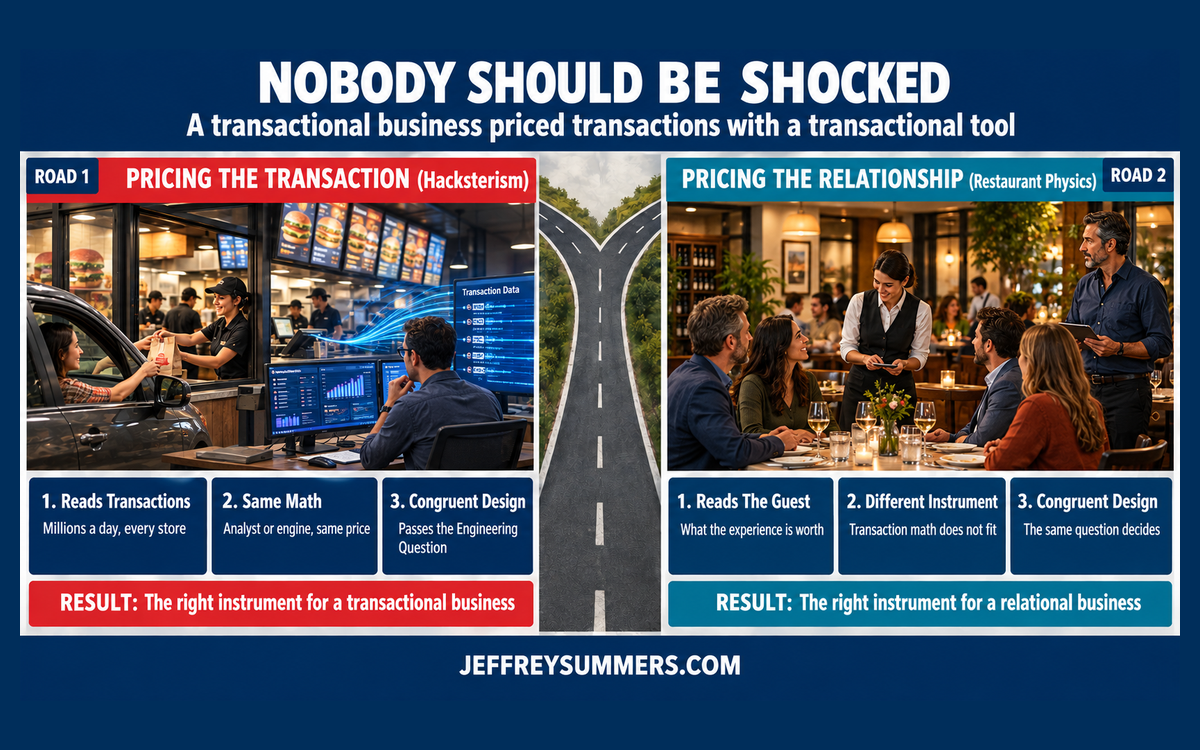

A Man In An Office Ran This Math First
Strip the AI out of the story and look at what is left. McDonald’s has long used Deloitte as its pricing consultant to provide pricing recommendations to restaurants. McDonald’s operators use third-party pricing advisers to help them set menu prices based on local market conditions. McDonald’s own standards document says franchisees “will continue to set their own prices and engage directly with the Third-Party Pricing Advisors.” And McDonald’s has used some form of an AI pricing tool since at least 2019. The engine Reuters wrote about in 2026 is not the start of anything. It is the newest instrument in a pricing operation that has been running on analysts, consultants, and transaction data for years. What does the engine do that the analyst did not? It reads more transactions, faster, and more often. That is the whole difference. An analyst at a desk pulls transaction data, models how Customers respond to price, applies the company’s rules, and sends a recommendation to the store. The engine pulls transaction data, models how Customers respond to price, applies the company’s rules, and sends a recommendation to the store. Same inputs. Same model. Same rules. Same recommendation landing on the same franchisee, who sets the same price in front of the same Customer. Fred Puech, a data scientist who builds pricing models for restaurant brands, put it plainly: “The ‘AI’ layer does not really change the story here.” Pooled data and modeling are, in his words, “standard practice in QSR.” So what’s the difference whether a guy sits in an office and runs the math or the AI tool does it? There isn’t one that matters to the price. The outrage is aimed at the instrument, and the instrument is the only part of the arrangement that is new.The Tool Passes The Engineering Question
The [Engineering Question] asks whether an area was engineered to operate this way, under these circumstances, congruent with the overall design of the business. Ask it of the pricing engine. In my [Two Roads] terms, McDonald’s is a Road 1 business on purpose. Its Customer comes for a transaction: speed, consistency, a known item at a known price. McDonald’s measures that transaction, prices that transaction, and makes the vast majority of its money as a percentage of its franchisees’ total revenue. Every part of that business is built around the transaction. A tool that reads transactions to price transactions fits it the way a fryer fits a fry station. It is congruent with the design at every level the question can be asked. Run it across the five Fundamentals and the answer does not change. Perspective. The business reads itself in transactions, and the tool reads transactions. There is no gap between how McDonald’s sees its business and what the engine sees. The gap is in the critics, who are reading a transactional business as if it owed the Customer a relationship it never offered. Product. The Customer buys a transaction, and the price is part of the transaction. A tool that tells the store where the price sits against what Customers in that area will pay is reading the Product, not corrupting it. My position on technology has not moved: tech that supports the CX is good, and tech that supplants the CX is bad. The engine does not take the order, hand over the bag, or stand at the counter. It supports the CX by reading it. It supplants nothing. People. The people running the math changed from analysts and consultants to an engine run by an outside firm, Tiger Analytics. The people living with the math did not change at all. The franchisee still reads a recommendation and sets a price. What changed for him is that a three-store owner now gets a read he could never have paid an analyst to build. Performance. McDonald’s sends pricing guidance at least three times a year, and the engine runs on business rules McDonald’s supplies. That is execution at scale of a pricing cadence the company already ran. Faster is not different. Profit. Headquarters earns on revenue. The franchisee earns on what is left after wages, rent, food, and fees, which the National Restaurant Association estimates are up 36% since 2019. That allocation is the same with an engine, with Deloitte, or with a district manager and a calculator. The tool did not create it and cannot remove it. Pull the tool out tomorrow and nothing about the design moves. The analyst comes back, the same data goes in, the same rules apply, and the same recommendation goes out. A fix that changes the instrument and leaves the design untouched is [Repair Work]. The critics are asking McDonald’s to repair something that is not broken.Who Cares Applies To Everyone
Take the hardest version of the complaint: McDonald’s says the AI doesn’t set the price, but it effectively compels the franchisee to use the tool, because engagement is required and deviations are recorded. Grant it. Who cares if they do. That answer holds for every actor in the story. McDonald’s built a transactional system and is engineering it with a transactional tool. A company is entitled to engineer its own system congruently. A single brand should be able to set its competitive pricing within its own brand. McDonald’s competes against Burger King and Chick-fil-A, not against itself. The franchisee bought into that system. He bought a transactional business with a franchisor that already sent him pricing guidance, already had a pricing consultant, and already reviewed him against value standards. A tool that reads more transactions than his own stores could ever generate is the system giving him more of what he signed up for. The Customer is buying a transaction. He reads the price at the counter and decides whether the meal is worth it. He has never asked, and has no reason to ask, whether the number came from a man in an office or a machine. And the critics are arguing about price math. Their complaint is that the math might push prices up, or push them unevenly, or push them without enough human hands on it. Every one of those is a transactional complaint about a transactional instrument. They are not arguing that McDonald’s should be a different kind of business. They are arguing about which calculator it uses.The Case Against, And Where It Breaks
The other side has a real case. Here it is at full strength, and where each point breaks. The data changed. The argument: an analyst worked from a sample, and the engine sees every store’s transactions, including the store down the road owned by a different franchisee. One party now sees everything. That is the strongest version of the concern, and it fails on the 300-unit franchisee. An operator with 300 stores pools the transactions of all 300 lawfully, because one owner is one business. He has always been able to build the read the engine builds. The three-store owner never could. Bar the franchisor’s tool and the only owner who loses the pooled read is the small one. So a mom-and-pop owner with three stores can’t use the same read as the 300-unit franchise? AI levels the playing field. The small owner gets the big operator’s capability, and with it the big operator’s goal: the price that maximizes the result under the conditions the store is in. Franchisees told Reuters the engine recommended large increases during the pandemic and after, as inflation soared, and that in recent months it has pushed more conservative pricing, including some decreases. Lower prices in a downturn are not a contradiction of maximizing. They are an ancillary benefit of maximizing pricing during an economic downturn. The rules follow other stores. The argument: the engine does not read this store’s Customer. It reads what other stores did. Two former Tiger Analytics employees told Reuters that McDonald’s regularly provided rules and corporate targets for the engine, including focusing increases on items that have not had a price increase in at least two years, only increasing prices on items that have had recent price increases in at least 30% of stores, and excluding ice creams and drinks from increases in the summer months. That 30% rule prices off other stores’ transactions, not off this store’s Customer and the value he is getting. True. And the 300-unit owner could run the same rule across his own stores tomorrow, and nobody would call it anything but pricing. The rule is not evidence against the thesis. It is evidence for it. A transactional business wrote a transactional rule that prices transactions off other transactions. That is the design working as designed. Advice or enforcement. The argument: a tool you are required to engage with, whose deviations are recorded and raised in your business review, is not advice. Here is the record on both sides. Since January, McDonald’s business standards have required franchisees to be “constructively engaging with McDonald’s approved Pricing Consultant and Tools.” McDonald’s says “value has been a key Business Review criteria for many years,” and that franchisees “will continue to set their own prices.” Against that, CEO Chris Kempczinski told investors in August that “pricing non-compliance in certain cases is part of those conversations.” A former franchisee, Karen King, described phone calls from corporate officers when she strayed from the recommendations and said, “You don’t really have much of a choice anymore.” Every responding franchisee in one owner survey opposed the standards changes, and CNBC reported that continued noncompliance could result in penalties or even termination. So is McDonald’s asking the franchisee to explain his thinking when he departs from the recommendation, or requiring him to follow it? “Constructively engaging” reads like the first. “Pricing non-compliance” reads like the second. That question stays open, and only because answering it means ascertaining intent, which the record cannot show, rather than measuring strict adherence to the tool’s use. Willingness to pay. The argument: one input the AI supercharges is an estimate of how much each store’s patrons are willing to pay, and an affordability bet cannot run on an engine that reads what the Customer will tolerate. McDonald’s told investors the engine is important to its corporate bet on affordability. Those look like opposites until you see what the estimate is for. It is about maximizing the utility of the pricing tool, not maximizing the price itself. A willingness-to-pay read tells the store where the price is soft as well as where it has room. It shows where price can come down and still win. That is a read in service of affordability, not against it. Traffic is down. The argument: U.S. foot traffic at McDonald’s has declined year over year for every complete month since March, according to Placer.ai estimates, so the engine is not working. Reuters reports that decline alongside the engine’s more conservative pricing. Nobody has shown the engine caused the decline, and this piece does not claim it did. What the record does show is narrower. Lower prices haven’t stopped the decline.The Shock Is The Story
The reaction to McDonald’s pricing engine is the subject here, and it explains itself away the moment you apply the transactional logic it is built on. A transactional business priced its transactions using a tool that reads transactions, and the people reacting are arguing over transactional math. Nothing in that chain is out of place. It is not inconceivable that franchisees are exploring their own AI pricing tools. They already use third-party pricing advisers to set menu prices on local conditions. A franchisee who wants his own read, built on his own stores and his own trade area, is reaching for the same instrument for the same reason McDonald’s did. When he gets there, nobody will call it a scandal. They will call it running his business. McDonald’s did not become a different company when it handed the math to a machine. It became a faster version of the company it already was. Whether a man in an office runs that math or an engine does, the price lands on the same counter, under the same allocation, in front of the same Customer, who is deciding the same thing he always decided: whether the transaction is worth it. Nobody should be shocked that a transactional business engineered its prices with a transactional tool. They should be shocked if it hadn’t.What You Do Monday Morning
Pull the last pricing recommendation you acted on, whether it came from a franchisor’s tool, a consultant, or your own spreadsheet. Next to each item, write the input the number was built on: your transactions, your costs, other stores’ prices, or your Guest’s read of what the experience is worth. Then ask the [Engineering Question] of it. Is that input congruent with the business you designed? If you run a transactional business, a transactional read is the right instrument, and your job is to read it and decide, not resent it. If you run a relational business, a price built on transactions is the wrong instrument no matter who runs the math, a man in an office or a machine.Digging Deeper
Positions on the record:- McDonald’s Only Had To Deny The AI — https://hacksterism.jeffreysummers.com/mcdonalds-only-had-to-deny-the-ai/ 2. McDonald’s Optimal Price Is Optimal For McDonald’s — https://hacksterism.jeffreysummers.com/mcdonalds-optimal-price-is-optimal-for-mcdonalds/ 3. AI Did Not Change What Your Operation Is — https://jeffreysummers.com/ai-did-not-change-what-your-operation-is/ 4. Same Drumbeat New Equipment 44 Years on Tech in Our Business — https://physics.jeffreysummers.com/same-drumbeat-new-equipment-44-years-on-tech-in-our-business-2/ 5. The Quagmire Of Franchising — https://hacksterism.jeffreysummers.com/the-quagmire-of-franchising/
Sources Cited In This Piece
- Reuters, September 29, 2026, “Inside McDonald’s push to have AI price your Big Mac” — machine-learning engine analyzing millions of daily transactions across nearly 14,000 restaurants to generate “the optimal price” at each location for each item; AI pricing tool in some form since at least 2019; Tiger Analytics runs the platform; two former Tiger employees: McDonald’s regularly provided rules and corporate targets, including focusing increases on items without a price increase in at least two years, only increasing prices on items with recent increases in at least 30% of stores, and excluding ice creams and drinks from summer increases; the January standard of “constructively engaging with McDonald’s approved Pricing Consultant and Tools”; the estimate of how much each store’s patrons are willing to pay; the affordability bet and the “industry-leading” engine; large increases during and after the pandemic and more conservative pricing, including some decreases, in recent months; Placer.ai: U.S. foot traffic down year over year for every complete month since March; Karen King: “You don’t really have much of a choice anymore”; Chris Kempczinski in August: “pricing non-compliance in certain cases is part of those conversations”; headquarters’ revenue share regardless of store margins; restaurant expenses up 36% since 2019 (National Restaurant Association estimate) — https://www.reuters.com/business/inside-mcdonalds-push-have-ai-price-your-big-mac-2026-09-29/ (syndicated text: https://www.cnbc.com/2026/09/29/inside-mcdonalds-push-ai-price-big-mac.html) 2. Nation’s Restaurant News, October 6, 2026 — “McDonald’s has long used Deloitte as its pricing consultant to provide pricing recommendations to restaurants” — https://www.nrn.com/quick-service/mcdonald-s-now-faces-a-lawsuit-over-its-pricing-recommendations 3. Franchise Times, December 12, 2025 — “McDonald’s operators use third-party pricing advisers to help them set menu prices based on local market conditions” — https://www.franchisetimes.com/franchise_news/mcdonald-s-brings-new-scrutiny-to-franchisee-pricing-in-move-to-emphasize-value/article_469cd5d6-ee22-4dfb-bbf2-c3e213cc3c9a.html 4. McDonald’s Corporation, “Supplemental Information on Global Franchising Standards Update” — “value has been a key Business Review criteria for many years”; “Franchisees will continue to set their own prices and engage directly with the Third-Party Pricing Advisors” — https://corporate.mcdonalds.com/content/dam/sites/corp/nfl/pdf/Supplemental%20Information%20on%20Global%20Franchising%20Standards%20Update.pdf 5. CNBC, February 11, 2026 — every responding franchisee in the Kalinowski owner survey opposed the standards changes; continued noncompliance could result in penalties or even termination — https://www.cnbc.com/2026/02/11/mcdonalds-value-franchisees.html 6. Fred Puech, Pricing Decisions (Substack), Part One of his series on McDonald’s AI-driven pricing — “The ‘AI’ layer does not really change the story here”; pooled data and modeling are “standard practice in QSR” — https://pricingdecisions.substack.com/p/mcdonalds-ai-driven-pricing-and-the
Discover more from Hacksterism
Subscribe to get the latest posts sent to your email.