McDonald’s pricing engine calculates the optimal price for the party that earns on revenue, and McDonald’s own documents put every consequence of that price on the franchisee, who earns on margin.
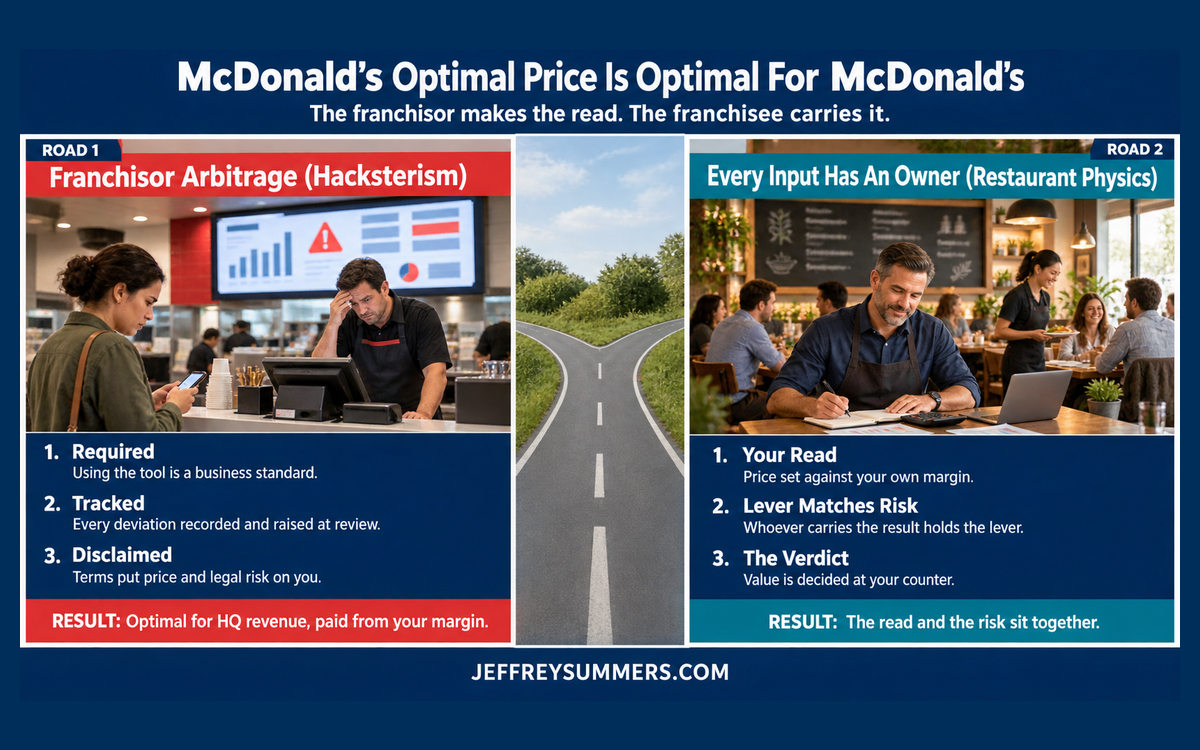
Reuters published the documents on September 29. The engine runs machine-learning models across millions of daily transactions in nearly 14,000 U.S. restaurants and generates what McDonald’s calls “the optimal price” for every item at every location. Since January, franchisees have been required to be “constructively engaging with McDonald’s approved Pricing Consultant and Tools.” McDonald’s records their deviations from its recommendations in detail, and its CEO told investors that “pricing non-compliance in certain cases is part of those conversations” in franchisee business reviews, and McDonald’s controls who renews and who grows. Then the terms of service for the same tool tell the franchisee he is “always free to determine the final price,” warn him that owners “may be competitors of each other” under antitrust law, and send him to his own attorney. The franchisor makes the read and holds the leverage. The franchisee holds the margin, the legal exposure, and the Customer standing at his counter. That allocation is the whole case, and every franchisee in every system that hands him an approved pricing tool is standing inside it.
The Franchisor Wrote Both Halves Down
Most franchise allocations have to be inferred from the architecture. This one is written down, by the franchisor, in its own words.
Here is the authority half. An internal communication sent to franchisees in January made engagement with the approved pricing consultant and tools part of McDonald’s new business standards. A franchisee document from June shows the company records deviations from the engine’s recommendations in detail. Company documents show pricing guidance going out at least three times a year. Five store owners told Reuters the company pressured them to use the tools. A former owner, Karen King, described phone calls from corporate officers when she strayed from the recommendations, and said, “You don’t really have much of a choice anymore.” And in August, Chris Kempczinski told investors that because of changes to how the company conducts franchisee business reviews, “pricing non-compliance in certain cases is part of those conversations.” Reuters sets that line beside the decisions McDonald’s controls that can make or break a franchisee: eligibility to renew and to open new stores.
Here is the exposure half. The pricing portal’s terms of service say owners “may be competitors of each other” and that “it is particularly important for all Users of the Tool to understand and comply fully with anti-trust and competition laws.” For guidance, franchisees should consult their own attorneys. And franchisees are “always free to determine the final price.”
Now McDonald’s response. It told PEOPLE that “AI does not set the price of a Big Mac or any other menu item,” that “McDonald’s franchisees make their own pricing decisions,” and that the portal is “a tool, not a mandate.” It called the reporting “speculative and uninformed.”
Take every word of it at face value. If the franchisee makes his own pricing decision, the decision is his, and so is everything that follows from it: the margin, the legal risk, and the Customer’s verdict. That is not a rebuttal of the allocation. It is the allocation, stated by the defendant. Then set it beside the rest. A tool, not a mandate, that franchisees are required to engage with, whose non-use is recorded in detail, followed up by phone, and raised at the review that decides whether you renew. Every one of those statements is McDonald’s. They are all true at once, and together they describe a franchisor that holds the price in practice and has disclaimed it on paper.
Optimal For Whom
The engine produces “the optimal price.” The word needs an owner, and Reuters supplies it.
McDonald’s headquarters makes the vast majority of its money by taking a percentage of franchisees’ total revenue, regardless of individual store profit margins. Franchisees make their money on what is left after wages, rent, food, and fees, and those restaurant expenses are up 36% since 2019 by the National Restaurant Association’s estimate. Those two parties do not want the same price. A lower price that sells more lifts revenue, and the franchisor’s percentage applies to every added dollar of sales whether or not that dollar carried any margin. A higher price that holds margin protects the franchisee and can cost the franchisor volume.
The engine has picked a side. Franchisees told Reuters it recommended large increases during the pandemic and after, as inflation soared, and that in recent months it has pushed more conservative pricing, including some decreases, which has caused friction with headquarters. In a meeting with investors this week, McDonald’s called the engine “industry-leading” and tied it to its corporate bet on affordability. Affordability for the Customer, funded out of the franchisee’s margin, scored on the franchisor’s revenue.
That is what “optimal” means in this system. It is optimal for the party whose income is a share of the top line. Nobody calculated it against the party whose income is the bottom line. The engine is not neutral, and it was never going to be, because it was built by the side of the table that does not carry the store.
That is [Franchisor Arbitrage] at the price layer: operating authority installed by the franchisor, run through business standards the franchisee did not negotiate, with the cost of the result carried by the franchisee. The January requirement arrived as a business standard, not as a term anyone signed into at the start. The operator who bought a McDonald’s before this year bought a business whose price would now be recommended, tracked, and reviewed from headquarters, by a party with a different stake in what that price should be.
The Engine Is Right About Markets
None of this is an argument against pricing by location. McDonald’s says restaurants a few miles apart can belong to distinct markets. It is right.
The Customer is not buying a Big Mac. He is buying a Big Mac here, now, in the time he has. In 2023 a Connecticut franchisee charged about $18 for a Big Mac meal off a state turnpike. His own filing says the price went viral and “caused no loss of sales.” Whatever the Customer on that turnpike was paying for, it was not only the meal. It was proximity, and time, and the absence of any alternative. Change the alternatives and the same Customer gives a different verdict on the same sandwich. Reuters found a company-run store in Fresno selling a Big Mac for $5.69 and another two miles away selling it for $6.89, a 21% premium, and it could not confirm whether the engine produced that gap or something else did. Two stores two miles apart can be selling two different transactions. Pricing them differently is sound operating.
So the read is legitimate. Somebody has to work out what each transaction is worth to the Customer at each store. The prosecution is not that the read happens. It is who makes it, and who lives with it when it is wrong.
A price set by a party with authority to compel, from outside the transaction between the buyer and the seller, is [Administered Pricing]. The franchisor is not at the counter. It is not in the building when the Customer checks the app and sees the store across town is cheaper. It does not answer the call when the Customer stops coming. It administers the price from a dashboard and collects its percentage either way.
The Franchisee Carries The Verdict
The Customer reads the price at the store. He does not read it as a micro-market. He reads it as the same Big Mac, from the same brand, on the same app, at a different price, and he does not blame an algorithm he has never heard of. He blames the restaurant he is standing in, and the person who owns it. The app McDonald’s built to bring him back is the same app that makes the comparison effortless. Reuters used it to find the Fresno gap.
Value is the Customer’s verdict. If he will not pay the price, there is no value at that price. If he pays, he judged there was enough value in the whole transaction, at that moment, against the alternatives he had. That verdict is real, and it is dated. It describes the visit he made, not the next one. An engine that reads last period’s transactions and sets the next price is reading a verdict that has already been given and treating it as permission. When the Customer revises his verdict, the franchisee finds out first, at his counter, and the engine finds out later, in the data. The trust that breaks in between is [Disearned Trust], and it is drawn against the franchisee’s account, not the franchisor’s.
Here is where the traffic stands. Despite the engine’s more conservative pricing, U.S. foot traffic at McDonald’s has declined year over year in every complete month since March, according to Placer.ai estimates. Nobody can show the engine caused that, and this piece does not claim it. What the number does show is that the engine’s “optimal” is not delivering the traffic it was optimized to buy. The franchisee carries his margin either way: thinner on the lower prices the engine recommends, and the same falling count of Customers through the door.
And then the legal exposure. U.S. courts and regulators are scrutinizing whether algorithmic pricing can facilitate illegal coordination between competitors, and franchisees are sometimes considered competitors. The tool’s own terms say so. The franchisor built the engine, fed it every franchisee’s transactions, populated it with competitors’ public menu prices, required engagement with it, and tracked who complied. The warning about what that might mean under antitrust law went to the franchisee, along with the suggestion that he hire his own lawyer.
The Diagnostic
Five questions for any franchisee whose system hands him an approved pricing tool. Answer each yes or no.
Did the last price change on your top five items come from a number you calculated against your own margin? If the recommendation came first and your number came second, the read is not yours.
Does your system record when you deviate from its recommendation? If it does, the tool is not optional, whatever the terms call it.
Does pricing come up in your business review, or in any conversation tied to renewal or expansion? If it does, the recommendation carries the weight of your renewal, and you are not free to determine the final price in any sense that matters.
Do the tool’s terms put the legal exposure on you? Read them. If they tell you to consult your own attorney about a tool you are required to use, the franchisor has already decided who carries the risk.
Is the tool optimized to your margin or to revenue? Ask the franchisor in writing. If the answer is revenue, or there is no answer, you know whose price it is.
Two yeses on the first four and the pricing authority in your restaurant has moved to headquarters. Four yeses and the last one does not need asking.
The Closer
McDonald’s optimal price is optimal for McDonald’s. It is calculated by the party that takes its share off the top line, required by business standards the franchisee never negotiated, tracked when he strays, and raised when he wants to grow, while the terms of the same tool tell him the price is his, the antitrust risk is his, and the lawyer should be too. Every input that moves your margin has an owner, and in this system the owner of the price has written itself out of every consequence of setting it.
What You Do Monday Morning
Pull the engine’s last recommendation for your top five items and put your actual price next to each one. For every item where you followed the recommendation, calculate your margin at the price you would have set against your own costs, and the margin at the price you charged. The difference, times the units sold, is what compliance cost you last period. For every item where you did not follow it, write down who called, when, and what was said. Then pull the terms of service for the pricing tool and highlight every sentence that tells you who carries what. That one page, and that one column of numbers, are the allocation in your own restaurant.
To understand the ideal state, go to Restaurant Physics.
Digging Deeper
Positions on the record:
-
Every Input That Moves Your Margin Has An Owner — https://physics.jeffreysummers.com/every-input-that-moves-your-margin-has-an-owner/
-
The Quagmire Of Franchising — https://hacksterism.jeffreysummers.com/the-quagmire-of-franchising/
-
An Open Letter To Franchisees: What You Actually Own — https://physics.jeffreysummers.com/an-open-letter-to-franchisees-what-you-actually-own/
-
An Open Letter To Wendy’s Part 2: Dear Meritage — https://hacksterism.jeffreysummers.com/an-open-letter-to-wendys-part-2-dear-meritage/
-
An Open Letter To Wendy’s Part 1: Dear Ohio — https://hacksterism.jeffreysummers.com/an-open-letter-to-wendys-part-1-dear-ohio/
-
Too Expensive Is A Verdict, Not A Price — https://jeffreysummers.com/too-expensive-is-a-verdict-not-a-price/
-
Every Read You Own Has A Date On It — https://physics.jeffreysummers.com/every-read-you-own-has-a-date-on-it/
Terms used in this piece: Franchisor Arbitrage, Administered Pricing, Disearned Trust. Definitions in the Knowledge Base (https://kb.jeffreysummers.com/).
Sources Cited In This Piece
-
Reuters, Waylon Cunningham, September 29, 2026 — the pricing engine analyzes millions of daily transactions across nearly 14,000 restaurants to generate “the optimal price”; the January requirement of “constructively engaging with McDonald’s approved Pricing Consultant and Tools”; the June franchisee document recording deviations in detail; guidance at least three times a year; five store owners describing pressure; Karen King: “You don’t really have much of a choice anymore”; Chris Kempczinski to investors in August: “pricing non-compliance in certain cases is part of those conversations”; business reviews and eligibility to renew or open stores; terms of service: owners “may be competitors of each other,” “it is particularly important for all Users of the Tool to understand and comply fully with anti-trust and competition laws,” consult their own attorneys, “always free to determine the final price”; headquarters makes the vast majority of its money from a percentage of franchisee revenue regardless of store margin; restaurant expenses up 36% since 2019 (National Restaurant Association estimate); the engine’s large increases during and after the pandemic and more conservative pricing in recent months; the investor meeting calling the engine “industry-leading” and tying it to affordability; the Connecticut franchisee’s roughly $18 Big Mac meal and the filing’s “caused no loss of sales”; Fresno $5.69 and $6.89, a 21% premium, not confirmed as the engine’s result; competitor menu prices in the platform; regulatory scrutiny of algorithmic pricing; Placer.ai foot traffic declining year over year every complete month since March; McDonald’s statements that restaurants a few miles apart can belong to distinct markets and that the portal is “a tool, not a mandate” — https://www.reuters.com/business/inside-mcdonalds-push-have-ai-price-your-big-mac-2026-09-29/
-
PEOPLE, September 30, 2026 — McDonald’s statements: “AI does not set the price of a Big Mac or any other menu item,” “McDonald’s franchisees make their own pricing decisions,” “The pricing portal is a tool, not a mandate,” and “These speculative and uninformed claims attempt to recast a standard business practice as something controversial” — https://people.com/mcdonalds-responds-to-claims-of-using-ai-for-food-prices-12149278