

What the sale is actually priced in
Every one of these purchases does the same structural thing: it puts something between an operator’s cast and an operator’s Guest. That is not a side effect of the convenience. That is the mechanism of the convenience. The efficiency exists precisely because a member of your cast is no longer standing in the middle of that exchange. And the moment nobody is standing in the middle of it, the operator can no longer tell the difference between a Guest who found the evening acceptable and a Guest who found it unmissable — because that difference produces no artifact. It exists only in the room, only while it is happening, only in front of a person capable of reading it. Remove the person and the difference does not become harder to see. It becomes structurally invisible. So the operator is not buying labor savings. He is buying labor savings with the ceiling on how much differentiated value his operation is capable of producing, and the invoice is denominated in dollars while the payment is drawn from an account nobody in the transaction has named. That is the arbitrage. It is priced in one currency and paid in another, and only one party to the deal knows both.The four arguments, and why each one fails
“It pays for itself in labor”
This is the load-bearing claim and it is always true. That is what makes it effective. The labor line does improve. The math on the slide is real math. It fails because the labor line is the only ledger in the calculation. There is no entry for the read that just went dark, because the read has never been assigned a dollar value by anyone selling into this industry — and the operator, who has never been handed a framework that prices it either, has no basis on which to object. Both parties agree to a number that omits the largest thing on the table, and the omission is invisible because it was never in anyone’s vocabulary. The cumulative failure is worse than the individual one. No operator buys one of these. He buys a kiosk in year one, a delivery platform in year two, tabletop ordering in year four, and each purchase is justified on its own labor line against a baseline that already contains the damage from the previous purchase. The ceiling comes down in steps, each step reads as responsible, and no single decision on the ledger ever looks wrong. This is [Operator Arbitrage] running on the operator’s own signature. What works instead. Demand the missing line item before you sign anything. Ask the seller to state, in writing, what the operation will no longer be able to detect after installation. He will not be able to answer, because the answer is not in the deck and never was. That refusal is your read.“It opens a new revenue channel”
Incremental orders. New Guests. Sales you would not otherwise have captured. Also frequently true, and also not the transaction being described. What the operator is actually buying is a permanent recalibration of what his Guests consider acceptable. Put your food on a delivery platform and a twenty-minute arrival in a paper bag is now part of your specification — not a promotion, not a channel, the spec. The Guest does not experience it as an experiment you are running. He holds you to it from that day forward, and he holds you to it at a price that has a platform’s margin already extracted from it. That is [Contract Drift], and it does not reverse when the promotion ends, because there is no promotion. There is only the new floor. Cumulatively, this is the more expensive of the two ratchets. Each convenience lowers what the operation can produce, and each channel raises what the Guest requires. Two lines moving toward each other, neither one reversible, and the space between them is the only room an operator has to be worth choosing rather than merely worth affording. What works instead. Price the channel on margin per cover and on what it does to your spec, not on gross incremental revenue. [Everything Is An Investment], which means every one of these has a return, a cost, and a term. Run all three or you are not evaluating it, you are just approving it.“Look at what this operator did with it”
The results slide. One operation, named, with a percentage on it. A retrospective outcome is not an executable path, and treating it as one is [Case Study Reduction]. You are looking at an operation with a different market, a different cast, a different concept, a different capital position, and a different starting ceiling, and you are being invited to conclude that the tool produced the result. Nobody in the room can establish that the tool produced anything, including the operator in the case study. And the selection is doing more work than the tool ever did. You are shown the operations where it went well. You are not shown the ones that installed the same product and spent the following three years discovering they could no longer tell why their Tuesdays were soft. Those operators are not in the deck. They are not in any deck. Most of them never worked out what happened, because the instrument that would have told them was the thing they removed. What works instead. Ask for the operations where it did not work and what specifically went wrong. A seller who cannot produce that list either does not track it or will not show it, and both answers tell you the same thing about the quality of the evidence you are being handed.“Guests want convenience”
The closer. Deployed as though it settles the question. Guests want the thing they were offered. Demand of this kind is manufactured downstream of design — you install the option, the option gets used, the usage is then presented back to you as proof of a pre-existing preference you had no choice but to serve. Nobody was standing in your dining room in 2011 demanding a tablet. And the argument quietly swaps out the subject. Convenience is a competitive claim available to every operator with a budget, which means it is a claim that resolves to price the moment two operators make it. Competing on how easy you are to transact with is the entrance to [Transactional Cost-Plus], and the exit is that price becomes the only variable you have left. [The Affordability Lie] is the belief that this was a demand problem in the first place. What works instead. Separate the two questions the argument collapsed. Convenience for whom, in what moment, at what cost to the read. A Guest who wants to pay quickly at the end of the meal and a Guest who wants to order without speaking to anyone are not the same Guest and not the same purchase. Design for the first one. The second one is the sale.The deeper mechanism
None of this requires a single dishonest vendor. That is what makes it durable. The floor is purchasable. It can be quoted, invoiced, installed, and financed. The ceiling is architectural — it comes from how the operation is designed, who is standing on the stage during peak, and how many tables a cast member is holding. Nobody can sell it to you, which means nobody can build a business on selling it to you. So an entire vendor economy exists that is structurally capable of selling operators only one of the two, and it is not the one that determines whether the operation is worth choosing. Every seller in the category is telling the truth about his own product and the aggregate effect is an industry that has walked its own ceiling down for fifteen years, one defensible purchase at a time, while calling it modernization. This is [Transactional Arbitrage] operating at the level of the whole trade rather than the individual deal.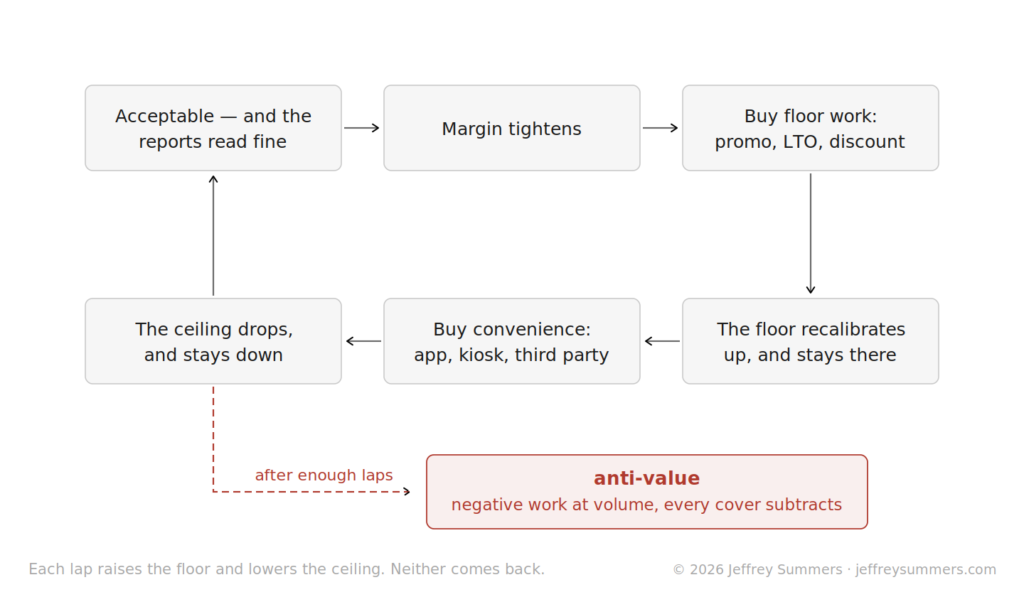 And the trade press amplifies it, because throughput has a number and a read does not. One of the industry publications will run a piece on labor savings per transaction this month. None of them will run a piece on what the operation can no longer detect, because there is no vendor buying advertising against that story.
The cruelest part is the arithmetic on the far side. Past the point where the rising floor crosses the falling ceiling, the operator can no longer be better — only cheaper. Every cover subtracts from his position instead of adding to it, and his volume becomes the mechanism of his erosion. He is not failing at that point. His reports are clean. He is succeeding perfectly inside a ceiling he sold, and the numbers that would tell him otherwise are the ones he traded away in year one.
And the trade press amplifies it, because throughput has a number and a read does not. One of the industry publications will run a piece on labor savings per transaction this month. None of them will run a piece on what the operation can no longer detect, because there is no vendor buying advertising against that story.
The cruelest part is the arithmetic on the far side. Past the point where the rising floor crosses the falling ceiling, the operator can no longer be better — only cheaper. Every cover subtracts from his position instead of adding to it, and his volume becomes the mechanism of his erosion. He is not failing at that point. His reports are clean. He is succeeding perfectly inside a ceiling he sold, and the numbers that would tell him otherwise are the ones he traded away in year one.
The diagnostic — run the deck backwards
Take the last three convenience purchases your operation made and put each one through four questions. One. What could a member of your cast detect before this was installed that nobody can detect now. Name it specifically or admit you never knew. Two. What did this permanently add to what your Guests consider acceptable. Price, speed, packaging, availability — name the new spec and confirm you are still meeting it every day. Three. What is it paying you, in the currency it was sold in. Get the real number, not the number on the slide from four years ago. Four. What is the removal cost today. Some of these are carrying revenue you cannot walk away from, and that is an investment decision, not a purge. Then run the free list, which is the one nobody sells and nobody audits. Tables per cast member during peak. Whether anyone capable of reading a table is on the stage during your busiest two hours. Whether your managers are in the office during the only hours that matter. Whether a survey link is standing in for a conversation. Every item on that list was installed for free by somebody in your operation, and every item on it can be removed for free by you.What you do Monday morning
Pull the invoice for your most recent convenience purchase and put it next to a blank sheet of paper. On the invoice is the price. On the sheet, write down what the operation stopped being able to see the week it went live. If you cannot fill the sheet, that is the finding. You bought something with a currency you have never once counted, from someone who was never required to quote it, and you have no idea what the balance is. That is the position the entire industry is standing in. The difference between you and the operator next door is whether you are willing to write the sheet.The closer
The deck was never wrong about labor. It was never wrong about throughput. It was never even wrong about the operator in the case study. It was wrong about the currency. Every one of those products was bought with the ceiling on what the operation could become, and not one seller in fifteen years has been asked to put that on a slide. [By Design Or By Default] — and this was default, purchased at retail, with a signature on it. To understand the ideal state, go to [Restaurant Physics](https://physics.jeffreysummers.com/you-cannot-buy-the-ceiling-back).Digging Deeper
Positions on the record- Why I Won’t Work For Franchisors — https://jeffreysummers.com/why-i-wont-work-for-franchisors/
- Why I Don’t Do Timed Contracts — https://jeffreysummers.com/why-i-dont-do-timed-contracts/
- You Cannot Buy The Ceiling Back — https://physics.jeffreysummers.com/you-cannot-buy-the-ceiling-back
- [Transactional Arbitrage] — https://kb.jeffreysummers.com/docs/transactional-arbitrage/
- [Operator Arbitrage] — https://kb.jeffreysummers.com/docs/operator-arbitrage/
- [Case Study Reduction] — https://kb.jeffreysummers.com/docs/case-study-reduction/
- [Contract Drift] — https://kb.jeffreysummers.com/docs/contract-drift/
- [Transactional Cost-Plus] — https://kb.jeffreysummers.com/docs/transactional-cost-plus/
- [The Affordability Lie] — https://kb.jeffreysummers.com/docs/the-affordability-lie/
- [Everything Is An Investment] — https://kb.jeffreysummers.com/docs/everything-is-an-investment/
- [By Design Or By Default] — https://kb.jeffreysummers.com/docs/by-design-or-by-default/
Discover more from Hacksterism
Subscribe to get the latest posts sent to your email.
