He was not wrong about the trend. That is the part nobody says out loud, and leaving it unsaid is why this pattern keeps recruiting.
Hot chicken got hot. Birria got hot. Smash burgers, elevated tacos, natural wine, omakase at a counter for nine people, the sourdough pizza with the leopard-spotted crust. Somebody read each of those early, put it in a market that did not have it yet, and made real money. Covers were real. Margin was real. The line down the sidewalk was real, and the write-up that called him the operator to watch was not flattery, it was reporting.
Then the window closed, the way a window always closes, and he found out what he had actually bought.
The Trend Was A Gap He Did Not Create
[Transactional Arbitrage] has three elements. There is a gap the actor did not create. There is a move that captures the spread inside that gap. And there is the exit risk that arrives when the gap closes, which the actor either times or absorbs.
A trend is the purest gap in this industry. The want already exists. It was manufactured somewhere else, by food media, by a city three flights away, by an algorithm that decided a particular dish photographs well. The operator did not make anyone want it. He noticed that people wanted it and that nobody within eleven miles was selling it, and he put it in a box with a lease on it.
That is the whole move, and it works. Being first or second into a market with demand that already exists is one of the highest-return plays available in this business, because the expensive half of a restaurant is normally the demand and here the demand arrives pre-built. He is not paying to teach a market to want something. He is paying rent and a buildout to be the nearest place to get a thing people already drove across town for.
Nothing about that is a moral failure. It is a trade, and executing a trade well is a skill. The prosecution in this piece is not that he ran it. The prosecution is what he told himself it was.
Heat Can Be Designed Or It Can Be Default
Some operators read the trend deliberately. They watch the coasts, they track what is landing in secondary markets, they run the numbers on a format before anybody local has heard of it, and they move. That is a designed arbitrage, and it is competent work.
Others just copied what was working. They drove past a line, went home, and changed the menu.
The distinction matters for exactly one thing, which is whether the operator knows what he is holding. It does not change the slope. [The Summers Principle] says every outcome traces to design or default and there is no third cause, and it applies here in a way the operator finds unwelcome: the window is the window either way. A designed arbitrage and a defaulted one expire on the same schedule, because the schedule was never his to set. He did not open the gap. He does not get to decide when it shuts.
The Reason The Heat Expires Is The Form, Not The Market
Here is where the industry’s explanation goes wrong, and it goes wrong in a way that protects everybody selling into the aftermath.
The story is that the market moved on. Guests are fickle now. The algorithm shifted. Everybody chases the next thing. All of that describes the weather and none of it describes the mechanism.
The mechanism is that a transactional architecture cannot manufacture a gap. It can only capture one. Manufacturing new demand means creating value that does not currently exist in the market, and creating value is the one move [Customer Architecture] is not built to run. It is built to move volume through a box at a spread. Ask it to produce a want nobody has yet and it has no instrument for the job, because none of its instruments make anything. They all move something that already exists from one side of a transaction to the other.
So when the novelty gap closes, and it always closes, nothing inside the operation can open another one. The operator reaches for what he has. Price. Promotion. Portion. Labor. Vendor terms. Every one of those is a subtraction dressed as a move, and he runs them in sequence while the room gets quieter, and the industry sells him a tool for each step.
The window did not close because the Guest got bored. It closed because the only thing holding it open was somebody else’s novelty, and novelty is a depreciating asset in every category that has ever existed.
The Peak Is The Most Expensive Part
Operators assume the damage is in the decline. It is not. The decline is where the bill arrives. The damage was done at the top.
At the peak, everything in the operation validates itself. Covers validate the concept. Margin validates the pricing. The line validates the format. The operator looks at the best numbers of his career and draws the only conclusion available to a man reading his own dashboard, which is that he built something that works.
He did not get a warning. He got a trophy.
And the trophy becomes the benchmark. Every target from that point forward is set against the window year. Every honest number afterward reads as underperformance. Every decision gets justified by pointing at a market condition that no longer exists, and the operator spends the next four years trying to get back to a number that was never a function of his operation in the first place.
This is [No Static Achievement] arriving in the most expensive possible form. Nothing accumulated can be held without continuing to be earned, and the window was never earned in a way that could be continued. It was collected. There is no version of paying harder that reopens a gap somebody else closed.
Duration Is Not Accumulation
Eight years in, the operator will tell you he has equity. The name means something in town. People know the place.
Ask what compounded and the answer does not arrive, because nothing did. He held a position for eight years while a window paid for six of them, and holding is not compounding. Time only works for an operator when something is being produced this period that becomes what next period runs on. The Guest who comes back because of what last month’s standard did to her is an input. The cast member who can now train the next one is an input. Money is not an input to anything until it is spent on something that produces value, which is why the window’s proceeds went into a second unit instead of a deeper bench.
That is the tell on the whole play. Ask him what his best year bought. If the answer is more boxes, the architecture converted. It did not compound.
And it is why he can walk away from the concept without grief. There is nothing to abandon. He believes he is carrying brand equity into the next thing and he is carrying a mailing list and a reputation for being early.
The Argument He Makes To Himself, In Order
These arrive in sequence, roughly a quarter apart, and each one is a real sentence real operators say. They are worth naming individually because each one has a different failure and a different price.
“We were killing it, so the model works.” The model did work, at the precise thing it was pointed at, for exactly as long as the gap stayed open. What the sentence does is convert a dated result into a permanent proof, and then use the proof to justify running the same machine into terrain the machine was never tested in. The cumulative damage is that it forecloses the read. An operator holding proof does not run a diagnostic. The move that would work is to date the proof out loud, month and year, and put the window’s start and end on the same page as the target.
“The market changed.” It did. It also changed for the operator two blocks over who is still full, and it changed in the same direction at the same speed. A condition that is held constant between two operators with different outcomes is not the cause of the difference. The cumulative damage here is worse than the individual error, because externalizing the close relocates every subsequent decision outside the building, and there is no lever out there. The move is to name two comparable operations in the same band in the same year and read whether they are holding.
“We just need to get the word out again.” Marketing spend can buy attention. It cannot buy back a want it never created. During the window, demand arrived free because something outside the operation was producing it, so acquisition cost was effectively zero and never appeared on any line. Now the operation has to pay retail for every visit, and the number lands in a business whose margin was modeled on free demand. Stacked, this one is the most expensive of the five, because it scales. The move is to total every dollar spent on demand since the peak and put it next to the covers it produced.
“We will refresh the concept.” This is the same arbitrage, run again, with less capital and a worse read. Reinvention is the most expensive way in this industry to avoid a conversation about what the operation actually produces. It also has a structural problem the operator cannot see from inside it: a refresh is a Product decision, and Product is caused by the read above it. If the read that chose the first trend has not changed, the refresh is an effect with no new cause, and the same operator will pick the same kind of gap again. The move is to state, in one sentence, what the operation is for, and check whether a contractor could have written it.
“We have been here eight years, we have equity.” Covered above. Duration is not accumulation. The cumulative effect of this one is that it buys silence. An operator who believes he has a reserve does not look for the subtraction, which is exactly the condition [Static Decline] describes. The runway hides the math, and here the runway was the window’s cash, the market’s memory, and the cast’s tenure, all three depleting on their own clocks.
The Deeper Argument: The Trend Answered The Question For Him
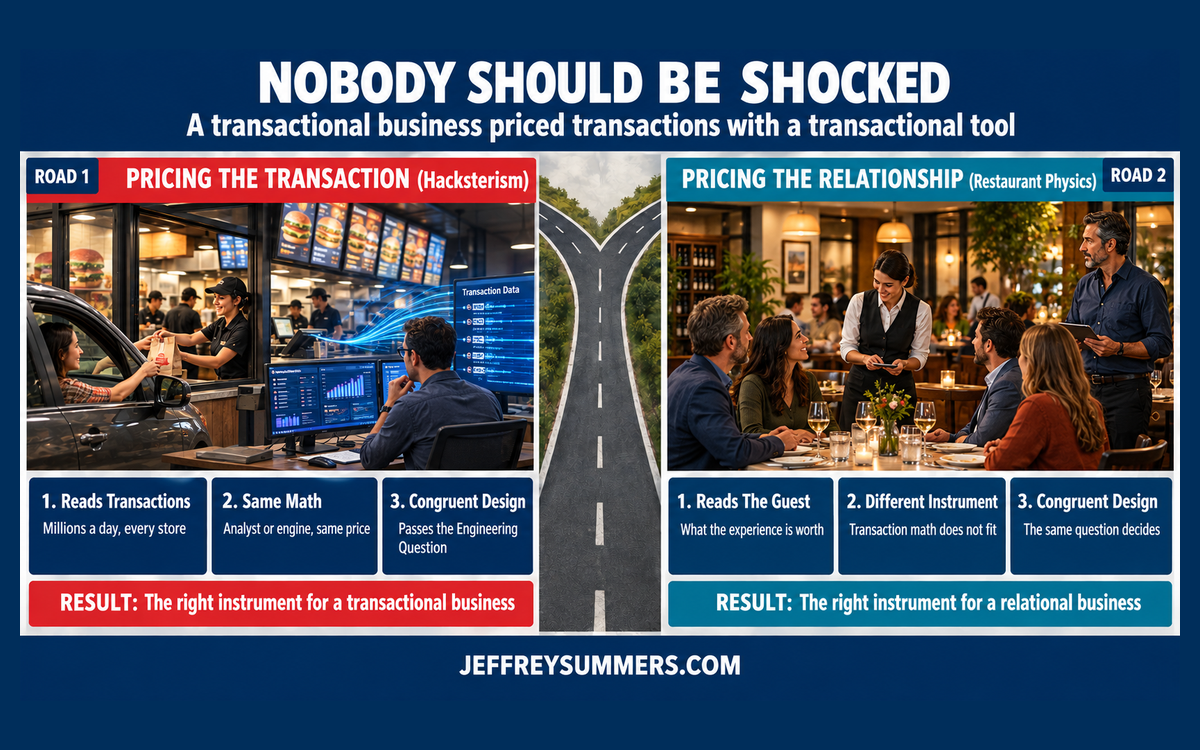
My framework has one fork at the top of it. Either the operator is asking what this operation costs him, or he is asking what it produces. That is [Two Roads], and every answer downstream of it inverts depending on which question got asked.
The trend operator never asked it. He did not choose Road 1 over Road 2 after weighing them. The window arrived pre-loaded with demand, which meant the only questions with any urgency attached were cost questions, and cost questions are the whole vocabulary of the transactional read. What does this shift cost. What does that hire cost. What does the spec cost. Every one of them got answered well, and the answers produced a very good four years.
So the road was not selected. It was defaulted into, and then it was paid for, which is the worst possible sequence, because getting paid for a default is what makes the default feel like a decision.
That is why the close feels like betrayal rather than arithmetic. He is not experiencing the failure of a choice he made. He is experiencing the expiry of a condition he was never tracking, which means nothing in his read can process what is happening, and a man whose read cannot process what is happening will buy anything that offers an explanation.
The Serial Arbitrageur Is Not Who This Is About
There is an operator who runs this deliberately, over and over, and he is not failing. He reads which trend has runway left, gets in early, runs the window hard, writes the box off and redeploys into the next one. Three, four, seven times across a career.
That is a competence, and it is not hospitality. He is a trader using restaurants as the vehicle, his skill is trend-reading and exit timing, and he is not confused about a single thing he is doing. My work has nothing to offer him. Selling him compounding would be selling him a horizon he has no interest in owning.
The operator this piece prosecutes is the one who ran the identical play believing he was building a restaurant. He did not plan an exit, because in his head there was nothing to exit. He put the window’s money into the buildout instead of into capability, and he is still standing in the box, at year nine, funding a closed gap out of his cast, his standard, and his name.
What He Spends While He Waits
Once the window shuts there are two branches and neither one is free.
He can keep investing to sustain the arbitrage, which means buying demand at retail in a business modeled on free demand. Or he can accept a smaller return every year because the alternative looks more expensive.
And the alternative genuinely is more expensive, which is why almost nobody takes it. Re-architecting is not starting something he never started. It is buying a second business while still operating the first one. Concept, positioning, menu architecture, pricing, cast capability, contract form. He paid for all of it once, aimed at the window. Doing it again means paying today’s prices, plus the cost of tearing out what is there, with a room emptier than it was back when he could have afforded the work. Retrofit is always a multiple of build, and he is shopping in distress, which is the worst rate anyone ever gets.
So he buys what is priced where he can reach. A refresh. An app. A retainer. A program with his objective printed on the cover. Each one is small, separately approved, and expensed in the month it lands, and none of them touches the architecture. That is not stupidity. It is a man buying the only thing on the shelf at his price point, and the vendor market is shaped the way it is shaped because that operator is the largest market in this industry, with the most urgency and the least capacity.
Nobody adds it up, and his own P&L is what prevents it. Marketing on one line, software on another, consulting somewhere else, promotional discounting buried in revenue. The total does not exist as a number anywhere in the business, so the comparison that would end this never gets run.
The Diagnostic
Five tests. Run them against the operation, not against the story about the operation.
Test One, the origination read. Name where the demand came from in the first two years. If you can name the trend, you rented it. If you can name a want that did not exist in the market until your operation produced it, you built something. There is no third answer, and hedging on this test is itself the result.
Test Two, the expiry read. Write down what would have to stay true for your current demand to hold five more years. If any item on that list is a category staying popular, you are holding a dated asset and the date is not yours to move.
Test Three, the copy read. Name three things this operation does that a competitor could not reproduce inside ninety days with your menu in hand and your build photographed. Specific capabilities, not adjectives. An operation that cannot fill all three lines was never differentiated, it was early.
Test Four, the benchmark read. Find the year your current targets are built off. If it is the window year, every plan in the building is aimed at a market condition that has expired, and every honest result will read as failure against it.
Test Five, the reacquisition total. Add every dollar spent since the peak aimed at bringing demand back. Marketing, agencies, apps, loyalty, promotional discounting, refreshes, programs, consultants who left a document. One number. Put it next to the covers it produced and next to what re-architecting would have cost in the first year after the peak. I do not know what your number comes to and I will not pretend to. I have never watched an operator run that total and come away still believing he took the cheaper path.
How it sorts. A rented origination with a clean copy read means you were early and then got good, and the work is to name what you built and fund it before the rest of the window goes. A rented origination with an empty copy read is an operation with no asset but its timing, and the decision in front of you is a decision about how long to sustain it. A built origination with a failed benchmark read means the business is sound and the targets are haunted, which is the cheapest of these to fix and the one operators fix last.
What You Do Monday Morning
Write down the month and year the peak ended. Not the year revenue dipped. The month the line stopped forming on its own, which you know, and which you have probably never written down.
Under that date, list every dollar that has left the business since aimed at demand, and next to each one write what it was supposed to bring back and whether it did.
Then write one sentence naming what this operation produces that nobody in your market can get anywhere else, in the present tense, with no reference to the trend that filled the room in the first place.
If that sentence comes out clean, you have an asset and the rest of this is a funding problem. If it will not come out, you have your answer, and it is the same answer whether you write the sentence or not. The only thing left to decide is how much longer you are willing to pay for the window.
The Closer
The trend paid him, and it paid well, and it was never his. He rented demand, ran it hard, and booked the proceeds as proof that he had built a business. The lease came due the way a lease does, on a date set by somebody who never met him, and the operation he actually owns turns out to be the one he was too busy to build while the room was full.
To understand the ideal state, go to Restaurant Physics.
Digging Deeper
Positions On The Record
1. You Keep Buying The Same Process Under Different Names — https://jeffreysummers.com/you-keep-buying-the-same-process-under-different-names
2. Demand You Create Is The Only Demand You Own — https://physics.jeffreysummers.com/demand-you-create-is-the-only-demand-you-own
3. The architecture taught in full, one fundamental at a time — https://physics.jeffreysummers.com/
Term Definitions From The Knowledge Base
Every term used here is defined in full in my Knowledge Base: https://kb.jeffreysummers.com/
Terms in this piece: Transactional Arbitrage, Restaurant Arbitrage, Customer Architecture, Guest Architecture, Two Roads, Static Decline, No Static Achievement, Positioning Capital, The Summers Principle, Hacksterism
Discover more from Hacksterism
Subscribe to get the latest posts sent to your email.