
The Vendor Said Yes Because Yes Is What Is For Sale
[Vendor Capture] names the condition where the solution defines the problem. The operator did not walk in with a diagnosed gap written in their own words with their own number attached. They walked in and got pitched, and the tool arrived before the problem did. There is a second direction that condition runs, and it is the one nobody talks about. The operator arrives with a uniqueness claim. Ninety percent of what that operation does is not unique and never was, but the claim is sincere, because the operator has been running those steps for years and they feel like the operation itself. The vendor has no stated position on what the product is for and what it will not do. So the vendor says yes, and keeps saying yes, until the vendor cannot describe what the platform is for either, because every account has taught it that the answer is whatever the account says. [Configuration Arbitrage] is what that yes actually is: a priced instrument, sold against a uniqueness claim the vendor has no position to refuse, monetized twice. First as the implementation and configuration work. Then as the remediation required when the custom build blocks the standard upgrade path. Three elements have to be present for anything in the arbitrage family, and all three are here. A gap the actor did not create, which is the gap between what the operator believes is unique and what actually differentiates. A capture move, which is the yes, billed at implementation. And an exit risk that closes the gap on some timeline, which is the version cycle, arriving to demonstrate that the customization was never differentiation and to charge the operator for being moved off it.I Have Been Saying This Since Before The Stack Had A Name
The industry’s counsel on technology has been the same counsel for as long as I have been in it, and I came in through a kitchen door in 1982. The counsel is always addition. There is always a new category, always a platform that will finally connect the pieces, always an integration that will make the operator’s life easier. And the counsel has never once addressed the question underneath all of it, which is what the operator is actually chosen for and whether the thing being sold has any relationship to it. That is not an oversight. An industry whose commercial apparatus is organized around selling addition cannot produce counsel about subtraction. The counsel is downstream of who pays for it.What The Vendor Says, And Why Each One Fails
We Can Configure It To How You Work
The individual dismantling. This is presented as accommodation and reads as expertise. The vendor is listening, the vendor is flexible, the vendor gets it. What has actually happened is that the vendor has surrendered its own diagnostic in order to close, and handed the operator a build nobody designed, on a platform that never had the limitation the build was made to satisfy. Why it fails at the mechanism level: nothing in the operator’s uniqueness claim was tested before it was implemented. No Guest was ever named. The question that would have to be asked — which of these steps has any Guest ever chosen or returned because of — was never asked by either party in the room, because neither party is paid to ask it. The cumulative impact. Stack this with the vendor’s other accommodations across its whole client base and the vendor becomes structurally incapable of having a product position. Then the operator inherits the consequence twice: once as their own configuration debt, and once as a platform whose roadmap is set by whoever asked loudest. The move that would work. The operator brings a written list of the surfaces the operation deliberately conforms on, and hands it to the vendor before the vendor presents. The conversation inverts. The vendor is now being asked to execute a standard cleanly rather than being invited to prove flexibility.Direct Ordering Is A Growth Strategy
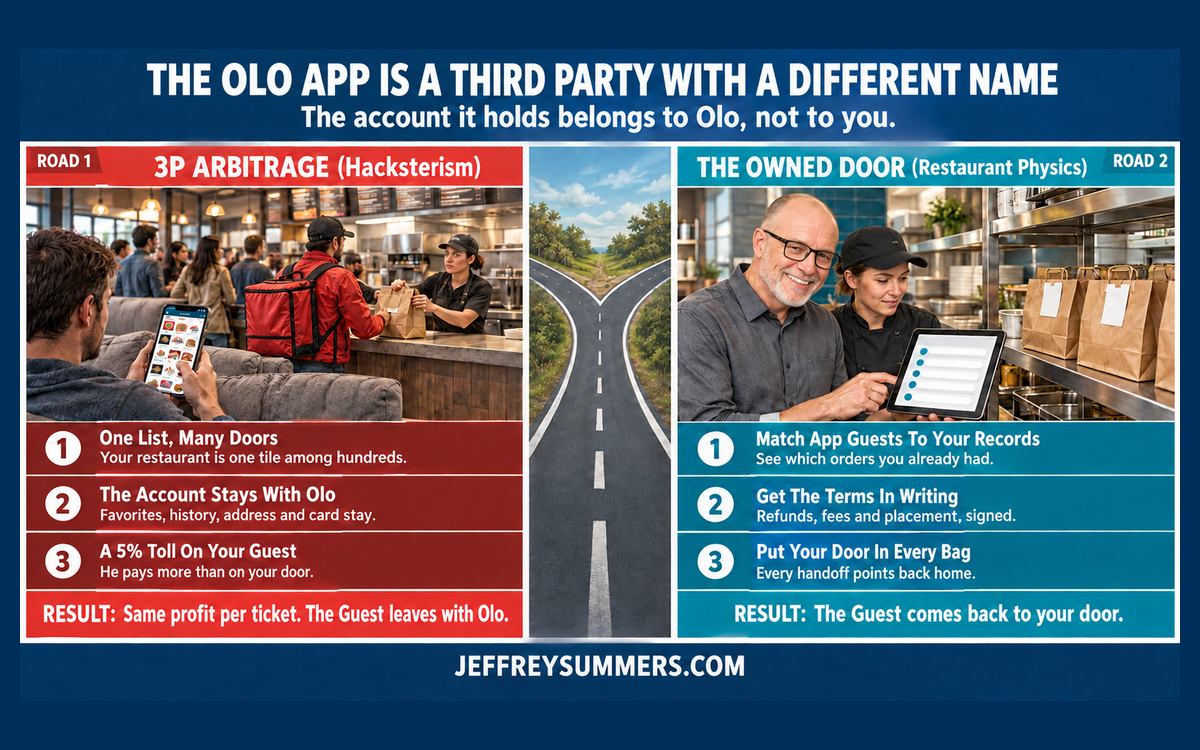
The individual dismantling. [Table-Stakes Repricing] is the manifestation that sells baseline restaurant infrastructure as a growth product. Direct ordering, mobile reservation, integrated loyalty, modern payment, an owned digital storefront. The pricing is not the failure. The framing is. These capabilities fulfill the operation’s baseline obligation to the Guest. They are what a current operator should already have. Sold as growth, they get budgeted out of the growth line and measured against growth expectations they were never going to meet. Why it fails at the mechanism level: baseline does not produce lift, it prevents loss. An operator who funds baseline out of the differentiation budget has spent the differentiation budget on staying even. The cumulative impact. The operator who was told baseline was growth, and then did not see growth, concludes that technology does not work and defers the next build. That deferral is [TableStakes Refusal], and the vacuum it leaves gets filled by a less committed party who is happy to own the Guest relationship the operator declined to own. The move that would work. Every recurring subscription gets sorted into exactly two categories: delivers growth above baseline, or fulfills baseline obligation. Anything in the second category that was sold in the first category gets repriced in the operator’s own head, funded out of the correct line, and measured against the correct expectation, which is that the Guest does not leave over it.Here Is Your Return On Ad Spend
The individual dismantling. [ROAS Lock] is the manifestation where the vendor arrives with the metric as part of the pitch, and the operator adopts it because the vendor introduced it rather than because the operator diagnosed a measurement gap the metric would fill. The number is real. The question of whether it is the operator’s question is never raised. Why it fails at the mechanism level: a measurement instrument supplied by the party being measured defines success as the thing that party produces. Ad spend produces attributable transactions, so attributable transactions become the read. Return visits, cohort tenure, and the interval between visits are not in the instrument, which means the operation stops reading the only numbers that describe a relationship. The cumulative impact. Stack it with the baseline misread and the operator now has a growth expectation funded out of the wrong line, measured by an instrument that cannot see the asset the operation actually runs on. The operation looks fine and hollows out, which is [Static Decline] with a dashboard. The move that would work. The operator writes down the measurement question before the vendor conversation, in their own words, with their own number attached. Any metric that arrives inside a pitch gets held against that written question, and the ones that do not answer it get declined out loud.We Will Preserve Your Unique Process
The individual dismantling. This is the most expensive sentence in the category, because a meaningful share of what any long-running operation calls its unique process is [Constraint Inheritance]. A step built to get around a limitation in a system the operation no longer runs, carried forward through enough handoffs that nobody left can source the reason. The general manager who remembered the limitation left. The kitchen manager who remembered the general manager left. By the third handoff the step is trained as doctrine and defended as identity, and it traces to nothing. Why it fails at the mechanism level: preserving it means paying a vendor to configure a modern platform to protect a dead constraint, at full implementation price, and then paying again at every version to keep protecting it. The operator is not buying continuity. They are buying an archaeology project with a subscription attached. The cumulative impact. This is how the accumulation gets into every new platform the operation will ever buy. Each migration carries the previous migration’s exceptions forward, because nobody can prove they are unnecessary, and [Complexity Decline] compounds across platforms rather than resetting at each one. The operator ends up with [Stack Drift] on the outside and an operation on the inside that spends more capacity managing its own accumulated exceptions than producing the Guest Experience those exceptions were supposed to protect. The move that would work. Before any configuration is requested, every step the operation treats as standard gets the three-whys pass. Name the constraint it was built against, and name whether that constraint still exists. A step that cannot produce its constraint does not get installed into the new platform. It gets left in the old one, where it belongs.And Then The Version Lands
The individual dismantling. The vendor knows the roadmap. The operator does not. When a custom build goes onto a surface the vendor has already scheduled for deprecation, the remediation is booked before the implementation is even finished. That is not bad luck. That is the second leg of the trade. Why it fails at the mechanism level: the version cadence becomes the clock. Configuration debt matures on the vendor’s release schedule rather than on the operation’s calendar, and every major version reopens the position. And the two charges arrive years apart, under different names, usually with different people on both sides of the table. Implementation gets filed as a project cost. Remediation gets filed as an upgrade cost. Nothing in the operation’s own records connects them, so the operator pays both halves of one trade and never sees it as one transaction. Ordinary product evolution is not this, and no vendor owes any operator a frozen platform. What makes it the play is selling flexibility on a surface already known to be going away, without saying so, and then charging to move the operator off it. The cumulative impact. Run this cycle twice and the operator has learned the wrong lesson. They conclude that platforms are a treadmill and that the cost of modernizing is just what it costs, which is precisely the belief that makes the third cycle easier to sell. The move that would work. Before signing, the vendor names the deprecation schedule for the surface the customization will be built on, in writing. No schedule, no customization. An operator who says that sentence out loud in a negotiation has removed most of their exposure in one move.A Thing Sold To Everyone Cannot Make Anyone Different
Here is the mechanism underneath all five arguments, and it is simple enough that the industry’s silence about it is the tell. The vendor’s promise of differentiation through configuration is a promise to sell the operator something the vendor does not have. And the proof is sitting in the vendor’s own business model, because the identical promise is made to every operator in the category. A capability sold to the whole market cannot differentiate anyone inside it. That is not an opinion about any particular vendor. That is arithmetic. The inputs in this industry converged, and not because operators failed. A handful of platforms matter. Broadline distribution consolidated, and the independent’s product list is substantially the same list the operation down the street orders off the same truck. The labor pool is one pool, drawn from the same few miles, moving between operations freely. [Structural Scale] is that same physics read from the cost side, and it forecloses input-side competition for the independent by math rather than by effort. So when a vendor offers differentiation, they are offering it on the one terrain where differentiation is structurally unavailable. And the operator buys, because the operator has never been taught the alternative, which is that the correct posture toward a fungible surface is to conform on it completely and on purpose. That is [Ordinary By Design], and its absence is the raw material this whole play runs on. There is one more layer, and it is the part that makes this a structure rather than a villain story. The group inside the vendor that says yes is not the group that inherits the yes. The motion that closes is insulated from the cost of closing, and the cost lands on implementation, on the group that inherits an account nobody can explain, and on a renewal three years out. Nobody in the building has to intend any of this for the play to run exactly as described. That is why the diagnostic cannot be built on intent.The Read You Can Run Without Knowing What Anybody Meant
Test One. Ask the vendor to name, in writing, the deprecation schedule for the surface your customization will live on. A vendor who will not name it is selling on a clock you cannot see. Test Two. Ask what the standard configuration is, and what the vendor refuses to do. A vendor with no refusals has no position, and you are buying every other client’s quirks along with the platform. Test Three. For each customization on the table, ask whether the vendor’s revenue goes up or down if you take the standard build instead. If every answer points the same direction, you are negotiating with someone whose incentive runs against your outcome. Test Four. Pull your last platform migration and total two numbers your books keep apart: everything paid to implement and configure it, and everything paid since to move, rebuild, patch, or remediate that configuration. That sum is the price of the yes. Almost no operator has ever seen it as one number. Test Five. For every capability presented as differentiating, ask how many operators in your market run the same capability. Ask it out loud, in the room. Test Six. Take the customization list from your last migration and name, next to each item, the Guest-facing consequence of having done it the standard way instead. Items with no answer were preferences you paid to hard-code. How the score sorts. An operator who can answer Four and Six has a reference price and a concession list, and is nearly impossible to run this play against. An operator who can answer neither is not being defrauded. They are being sold to, exactly as designed, and the invoice they will pay twice is already in motion.What You Do Monday Morning
Pull the last platform migration and run Test Four. Two numbers, added together, out of two different places in your own books. Implementation and configuration on one side. Everything paid since to move, rebuild, or remediate that configuration on the other. That single figure becomes your standing reference price for what a yes costs, and you quote it out loud the next time a vendor accommodates an exception. Not as an accusation. As a number, which is the only language that survives a sales conversation intact. The operator who has run that number stops asking a platform to make the operation distinctive and starts asking whether it executes a standard cleanly and then gets out of the way. That is a different buyer, and vendors can tell the difference within about four minutes. You did not get cheated. You got accommodated, and then you paid for it twice under two different names in two different years, which is exactly what the accommodation was for. The yes was never a favor. The yes was the product. To understand the ideal state, go to Restaurant Physics.Digging Deeper
Positions on the record- Differentiation Was Never For Sale — https://physics.jeffreysummers.com/differentiation-was-never-for-sale
- You Keep Buying The Same Process — https://jeffreysummers.com/you-keep-buying-the-same-process
- You Did Not Build A Restaurant, You Rented A Trend — https://hacksterism.jeffreysummers.com/you-did-not-build-a-restaurant-you-rented-a-trend
- Demand You Create Is The Only Demand You Own — https://physics.jeffreysummers.com/demand-you-create-is-the-only-demand-you-own
- AI Did Not Change What Your Operation Is — https://jeffreysummers.com/ai-did-not-change-what-your-operation-is
- [Vendor Capture] — https://kb.jeffreysummers.com/
- [Configuration Arbitrage] — https://kb.jeffreysummers.com/
- [Table-Stakes Repricing] — https://kb.jeffreysummers.com/
- [ROAS Lock] — https://kb.jeffreysummers.com/
- [TableStakes Refusal] — https://kb.jeffreysummers.com/
- [Constraint Inheritance] — https://kb.jeffreysummers.com/
- [Complexity Decline] — https://kb.jeffreysummers.com/
- [Stack Drift] — https://kb.jeffreysummers.com/
- [Ordinary By Design] — https://kb.jeffreysummers.com/
- [Structural Scale] — https://kb.jeffreysummers.com/
- [Static Decline] — https://kb.jeffreysummers.com/
Discover more from Hacksterism
Subscribe to get the latest posts sent to your email.