
McDonald’s denied the AI story because the AI story was the only part of the reporting it could deny, and the coverage that turned a franchise story into an AI story let every franchisor in the country walk away from it.
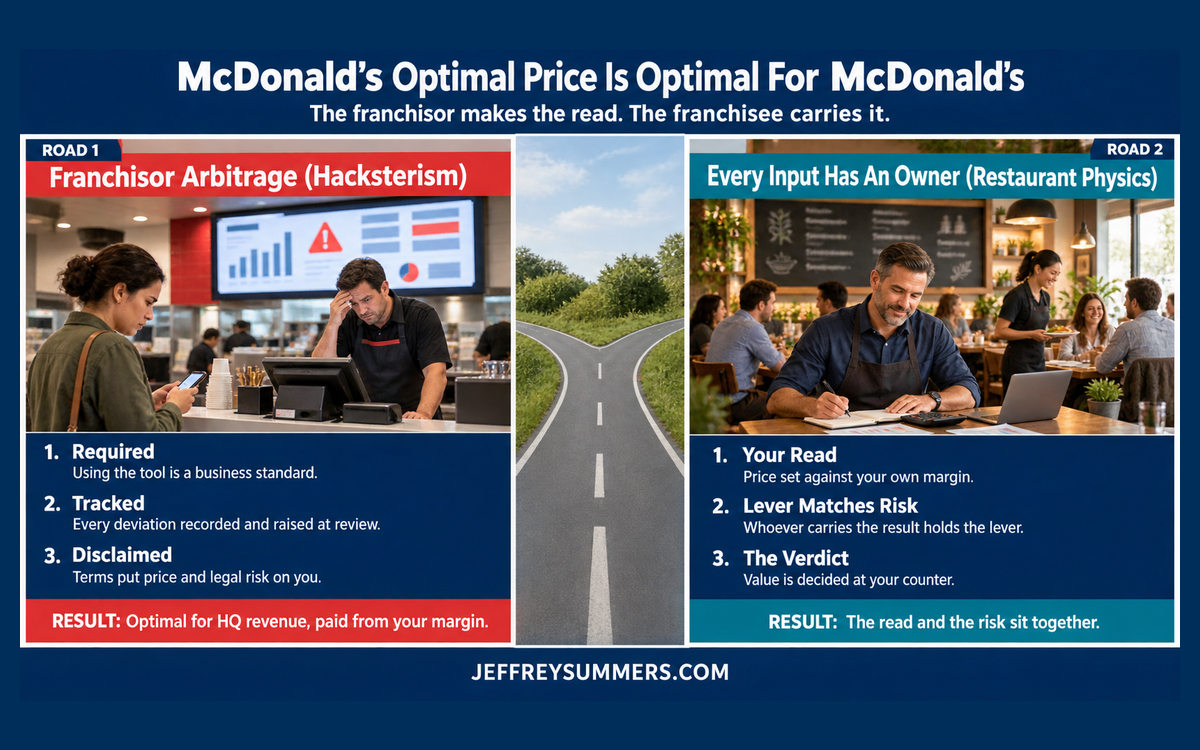
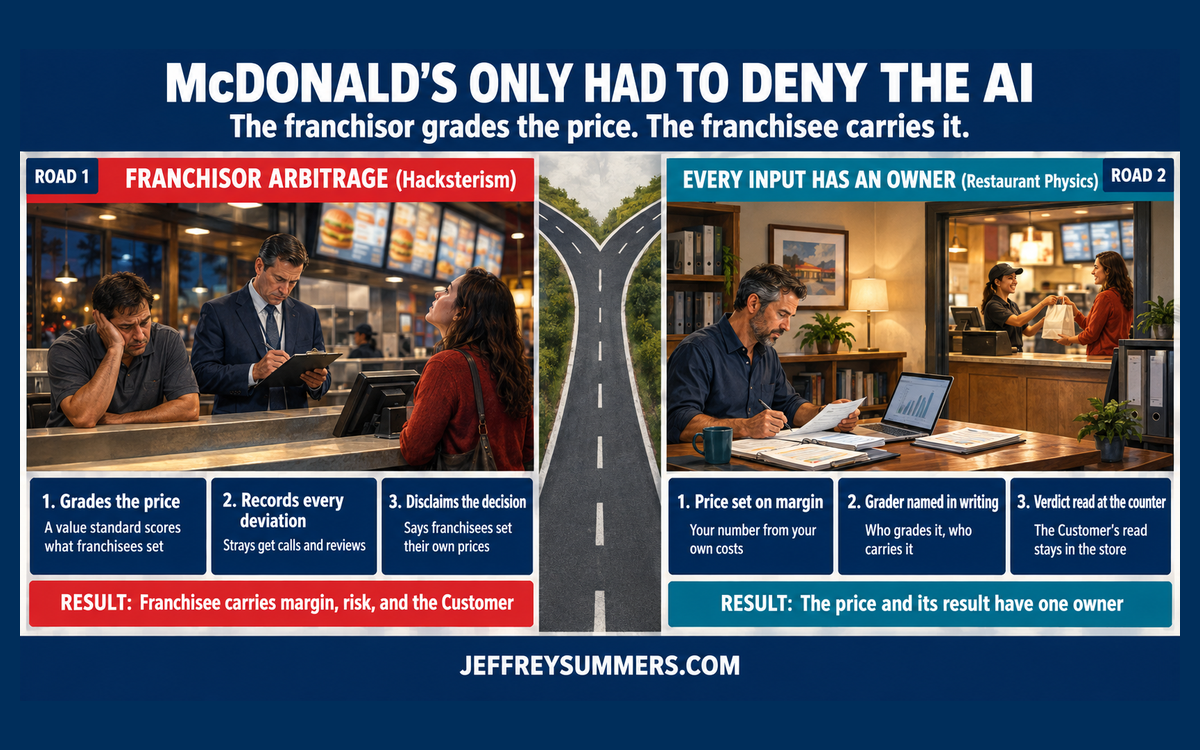
This week McDonald’s published “Separating Fact from Fiction: AI Does Not Set Prices at McDonald’s,” and its global chief impact officer, Jon Banner, told the world that “Reuters got it wrong.” The fact sheet denies five fictions: that AI sets the price, that the tool prices individual Customers by their willingness to pay, that McDonald’s uses dynamic pricing, that pricing analytics are controversial, and that McDonald’s dictates the prices franchisees must charge. Reuters reported none of them as fact. What Reuters did report is that McDonald’s requires franchisees to engage with its pricing tools, records when they deviate, calls them when they stray, raises pricing non-compliance in the reviews that decide who renews, and makes its money on a share of their revenue whatever their stores make. The fact sheet does not deny any of that. In one paragraph it confirms it. The franchisor grades the price, the franchisee owns it, and the franchisee carries the result. That is not an AI story. It is how franchising works, and the story nobody told is the one every franchisee in every system is standing inside.
McDonald’s Denied Five Things Nobody Reported
Put the fact sheet next to the reporting it answers.
The fact sheet says the tool “does not set prices based on an individual customer’s willingness to pay and does not set prices for individual customers.” Reuters never said it did. Reuters reported an estimate of “how much each store’s patrons are willing to pay,” and a franchisee screen reading “Your restaurant is showing medium sensitivity to price,” based in part on “customer willingness to pay in your area.” A store. An area. Not an individual. McDonald’s corrected a claim by changing one word in it.
The fact sheet says McDonald’s does not use dynamic pricing and the tool “does not change prices in real-time or at different hours during the day.” Reuters never said it did. The only time “dynamic pricing” appears in the Reuters report, it is describing Wendy’s in 2024.
The fact sheet says “AI sets menu prices at McDonald’s” is fiction. Reuters wrote that McDonald’s is using AI “to guide menu prices,” and it opened its account of the franchisees with this: “McDonald’s says its franchisees are free to set their own prices, but five store owners told Reuters the company pressured them to use the AI-pricing tools.” The franchisee setting the price was in the report. So was the pressure.
The fact sheet says “McDonald’s dictates the prices franchisees must charge” is fiction, and answers that “franchisees are not required to accept a pricing recommendation.” Reuters never said they were. Reuters said that since January, McDonald’s business standards have required franchisees to be “constructively engaging with McDonald’s approved Pricing Consultant and Tools.” Required to engage. Not required to accept. The fact sheet denies the second and says nothing about the first.
Five denials, and every one of them lands on a claim the reporting did not make. The requirement to engage, the record of deviations, the calls from corporate officers, the CEO telling investors in August that “pricing non-compliance in certain cases is part of those conversations” in franchisee business reviews: none of it appears in the fact sheet, because none of it can be denied.
The One Paragraph That Concedes
The sixth fiction on the sheet is “McDonald’s franchisee value standards are simply about policing prices.” Here is the answer, in full: “McDonald’s has a value standard for franchisees that is designed to reinforce accountability for delivering the experience and value customers expect from McDonald’s. The assessments are holistic. Price is one consideration among many aspects of the customer experience that shape whether customers believe they received good value.”
Read it for what it admits. There is a standard. The franchisee is assessed against it. The standard exists to “reinforce accountability.” And price is one of the things assessed. The word “simply” is carrying the entire denial. McDonald’s is not saying the value standard does not grade the price. It is saying the value standard grades more than the price.
That is the pressure Reuters described, in McDonald’s own words, published by McDonald’s to prove Reuters wrong. A franchisee whose price is graded inside a standard designed to reinforce accountability, at a company that controls whether he renews and whether he opens another store, is not setting his price in any sense that matters to him. He is setting it under review.
The Coverage Wrote McDonald’s Its Exit
McDonald’s did not invent the five fictions. The coverage did.
Reuters’ headline was “Inside McDonald’s push to have AI price your Big Mac,” and its own social account said McDonald’s uses AI “to help set menu prices.” The body of the report was careful. The headline and the post were not, and most of what came after was built on the headline. Engadget ran “McDonald’s is reportedly using AI to ‘dynamically’ price its burgers” and called it “basically surge pricing, like with ride-share platforms.” Yahoo Finance ran “McDonald’s Deploys AI to Drive Dynamic Menu Pricing Across US Restaurants” and wrote that McDonald’s is using AI “to set menu prices.” Polymarket posted that McDonald’s “begins using AI to calculate how much customers are willing to pay.” On LinkedIn, a franchise-industry board member told operators that Reuters reported the engine “is widening price differences,” when Reuters reported that three franchisees said so and could not confirm the Fresno gap was the engine’s doing.
Every one of those is a version of the story McDonald’s could kill with one sentence. Dynamic pricing: we do not. Surge pricing: it does not change prices in real time. AI sets the price: people do. The coverage did not just get the story wrong. It wrote McDonald’s the fact sheet. Each overstatement became a fiction McDonald’s could stand next to and deny, and the fact sheet reads as a correction of the record because the record the public saw had been bent before McDonald’s ever answered it.
The cost of that is not to McDonald’s reputation. It is to the franchisee. The story that should have been argued, that the franchisor grades a price it disclaims, never got argued loudly enough to need an answer. The [Counsel Class] had the documents. It argued the version that was easiest to deny and left the one that was hard to deny on the table.
This Was Never An AI Story
Take the AI out of the Reuters report and nothing important changes.
A franchisor builds a tool that recommends a price. It requires the franchisee to engage with the tool. It records when he deviates. It grades the price inside a standard tied to accountability. It decides whether he renews and whether he grows. It collects its royalty as a percentage of his revenue, regardless of what his store makes. He pays the wages, the rent, the food, and the fees out of what is left, and those costs are up 36% since 2019 by the National Restaurant Association’s estimate. The Customer reads the price at his counter, not at headquarters, and takes it out on him.
None of that needs machine learning. A spreadsheet does it. A district manager with a clipboard does it. The engine is the newest instrument for an allocation franchising has always run: the franchisor influences the price and the franchisee carries the result. That is [Franchisor Arbitrage] at the price layer. A price shaped by a party with the authority to compel, from outside the transaction between the store and the Customer, is [Administered Pricing], whether the party administering it uses an algorithm or a phone call.
That is why the AI framing was so expensive. An AI story is a McDonald’s story. McDonald’s has the engine, McDonald’s got the headline, McDonald’s published the denial, and the story closes when the denial lands. Every other franchised system that grades the price its franchisees set, through value audits, business reviews, required promotions, or price-point mandates on a value menu, got to sit it out. Read correctly, the Reuters report is about every franchisor that influences a price while its franchisee carries the margin. Read as an AI story, it is about one company, and that company has now said its piece.
The Denial Was Written For Regulators
The fact sheet is not careless, and it is not for the public. Look at who signed the companion post. Jon Banner’s title begins with Government Relations and Global Policy.
Reuters reported that U.S. courts and regulators are scrutinizing whether algorithmic pricing can facilitate illegal coordination between competitors, and that franchisees are sometimes considered competitors. The pricing tool’s own terms tell franchisees they “may be competitors of each other” and that “it is particularly important for all Users of the Tool to understand and comply fully with anti-trust and competition laws.” The Justice Department has spent the last year settling its case against the rent-pricing software company RealPage and the landlords who used it.
Now read the fact sheet again. “Franchisees independently set their menu prices.” “People make the final pricing decisions.” “Not a mandate.” Every line places the decision with the independent owner, because independent owners setting their own prices do not coordinate, and a hub that only recommends is not running the spokes. That is a legal position, and it is the right one for McDonald’s to take. It is also the allocation. If the decision is the franchisee’s, so is the exposure. The tool’s terms already told him so, and told him to consult his own attorney.
McDonald’s Has Run This Play Before
In May 2024, McDonald’s USA president Joe Erlinger published “Providing meaningful value to our fans, with a side of facts,” with a companion sheet titled “U.S. Pricing Myths vs. Facts.” The occasion was an $18 Big Mac meal on a Connecticut turnpike that went viral. The answer was the same: “Our franchisees (who own and operate more than 95% of all restaurants in the U.S.) set menu prices for their restaurants.”
Two years, two pricing controversies, two myth-and-fact sheets, one sentence. When the price draws attention, the franchisee sets it.
It is not only McDonald’s. Five days before the fact sheet, Walmart’s CEO, John Furner, wrote about Walmart’s new digital shelf labels: “We don’t set different prices based on who you are or the time of day, and we won’t.” Not individual Customers. Not time of day. The same denials, in the same order, from a different company. The template now runs on its own. Deny the version regulators are already chasing, dynamic and personalized pricing, and say nothing about the version you actually run.
The Closer
McDonald’s only had to deny the AI, because the AI was the only part of the story anyone told loudly enough to be answered. The franchisor grades the price in a standard built to reinforce accountability, records the deviations, raises them at renewal, and collects on revenue whatever the store makes, and in the same breath it says the franchisee sets the price. Both are true. That is the arrangement. The franchisee sets the price the franchisor grades, and he keeps everything that follows from it: the margin, the legal exposure, and the Customer standing at his counter.
What You Do Monday Morning
Pull your franchise agreement and every operating standard your system has issued since you signed it. Mark every place price is assessed: a value standard, a business review criterion, a required promotion, a price point you are expected to hit. Next to each one, write two things. Who grades it. And who carries the result when the grade and the margin disagree. If the first column says the franchisor and the second column says you, you are holding the same allocation McDonald’s just published, and the next time your franchisor says franchisees set their own prices, you will know exactly which half of that sentence is yours.
To understand the ideal state, go to Restaurant Physics.
Digging Deeper
Positions on the record:
-
McDonald’s Optimal Price Is Optimal For McDonald’s — https://hacksterism.jeffreysummers.com/mcdonalds-optimal-price-is-optimal-for-mcdonalds/
-
Every Input That Moves Your Margin Has An Owner — https://physics.jeffreysummers.com/every-input-that-moves-your-margin-has-an-owner/
-
The Quagmire Of Franchising — https://hacksterism.jeffreysummers.com/the-quagmire-of-franchising/
-
An Open Letter To Franchisees: What You Actually Own — https://physics.jeffreysummers.com/an-open-letter-to-franchisees-what-you-actually-own/
-
The Restaurant Industry Advice You Get Comes From People Who Cannot Afford To Be Wrong — https://jeffreysummers.com/the-restaurant-industry-advice-you-get-comes-from-people-who-cannot-afford-to-be-wrong/
-
I Read The Restaurant Industry News Wrong, And So Did Everyone It Reached — https://jeffreysummers.com/i-read-the-restaurant-industry-news-wrong-and-so-did-everyone-it-reached/
Terms used in this piece: Franchisor Arbitrage, Administered Pricing, Counsel Class. Definitions in the Knowledge Base (https://kb.jeffreysummers.com/).
Sources Cited In This Piece
-
McDonald’s Corporation, “Separating Fact from Fiction: AI Does Not Set Prices at McDonald’s,” published September 30, 2026, distributed October 1, 2026 — the five fictions and facts; “does not set prices based on an individual customer’s willingness to pay and does not set prices for individual customers”; “does not change prices in real-time or at different hours during the day”; “The tool provides information. People make the final pricing decisions”; “Franchisees independently set their menu prices”; “a recommendation, not a mandate. Franchisees are not required to accept a pricing recommendation”; the value standard paragraph quoted in full — https://www.marketscreener.com/news/separating-fact-from-fiction-ai-does-not-set-prices-at-mcdonalda-s-ce785ddadb8df225
-
Jon Banner, X, September 30, 2026 — “Reuters got it wrong”; “AI does not set Big Mac prices, make automatic price changes, or determine what individual customers pay” — https://x.com/jon_banner1/status/2105128064262824011
-
Jon Banner, LinkedIn post, October 1, 2026 — title EVP and Global Chief Impact Officer, Government Relations, Global Policy; “our franchisees always make the final decision on menu prices” — https://www.linkedin.com/in/jon-banner/
-
Reuters, September 29, 2026, “Inside McDonald’s push to have AI price your Big Mac” — AI used “to guide menu prices”; the estimate of “how much each store’s patrons are willing to pay”; the interface message “Your restaurant is showing medium sensitivity to price” based in part on “customer willingness to pay in your area”; “McDonald’s says its franchisees are free to set their own prices, but five store owners told Reuters the company pressured them to use the AI-pricing tools”; the January standard of “constructively engaging with McDonald’s approved Pricing Consultant and Tools”; deviation records; calls from corporate officers; Chris Kempczinski in August: “pricing non-compliance in certain cases is part of those conversations”; renewal and expansion decisions; headquarters’ revenue share regardless of store margin; costs up 36% since 2019 (National Restaurant Association estimate); three franchisees on widened price gaps; the Fresno gap not confirmed as the engine’s result; antitrust scrutiny of algorithmic pricing; the tool’s terms on competitors and antitrust law and on consulting their own attorneys; “dynamic pricing” used only of Wendy’s in 2024 — https://www.reuters.com/business/inside-mcdonalds-push-have-ai-price-your-big-mac-2026-09-29/ (syndicated text: https://www.cnbc.com/2026/09/29/inside-mcdonalds-push-ai-price-big-mac.html)
-
Restaurant Business — Reuters’ social account: McDonald’s uses “artificial intelligence to help set menu prices”; the Polymarket post: “begins using AI to calculate how much customers are willing to pay” — https://restaurantbusinessonline.com/financing/mcdonalds-has-another-pricing-related-headache
-
Engadget, Lawrence Bonk, September 29, 2026 — “McDonald’s is reportedly using AI to ‘dynamically’ price its burgers”; “basically surge pricing, like with ride-share platforms” — https://www.engadget.com/2272211/mcdonalds-is-reportedly-using-ai-to-dynamically-price-its-burgers/
-
Yahoo Finance, Aditya Raghunath, September 30, 2026 — “McDonald’s Deploys AI to Drive Dynamic Menu Pricing Across US Restaurants”; “using artificial intelligence more and more to set menu prices” — https://finance.yahoo.com/technology/ai/articles/mcdonald-deploys-ai-drive-dynamic-120848596.html
-
McDonald’s USA, Joe Erlinger, May 29, 2024, “Providing meaningful value to our fans, with a side of facts” — the $18 Big Mac meal; “Our franchisees (who own and operate more than 95% of all restaurants in the U.S.) set menu prices for their restaurants” — https://corporate.mcdonalds.com/corpmcd/our-stories/article/providing-meaningful-value-to-our-fans-with-a-side-of-facts.html
-
McDonald’s USA, “U.S. Pricing Myths vs. Facts,” 2024 — https://corporate.mcdonalds.com/content/dam/sites/corp/nfl/pdf/McDUS%20Pricing%20Myths%20vs%20Facts%20052924.pdf
-
Los Angeles Times, Anne D’Innocenzio, September 28, 2026 — Walmart CEO John Furner, writing Friday: “We don’t set different prices based on who you are or the time of day, and we won’t” — https://www.latimes.com/business/story/2026-09-28/as-walmart-expands-digital-shelf-labels-ceo-says-prices-wont-depend-on-who-you-are
-
AP, November 25, 2025 — the Justice Department’s settlement with RealPage over algorithmic rent pricing — https://apnews.com/article/realpage-doj-lawsuit-settlement-rent-data-4d8985a50c28b6322b8f82a2fbb5c79e
Discover more from Hacksterism
Subscribe to get the latest posts sent to your email.