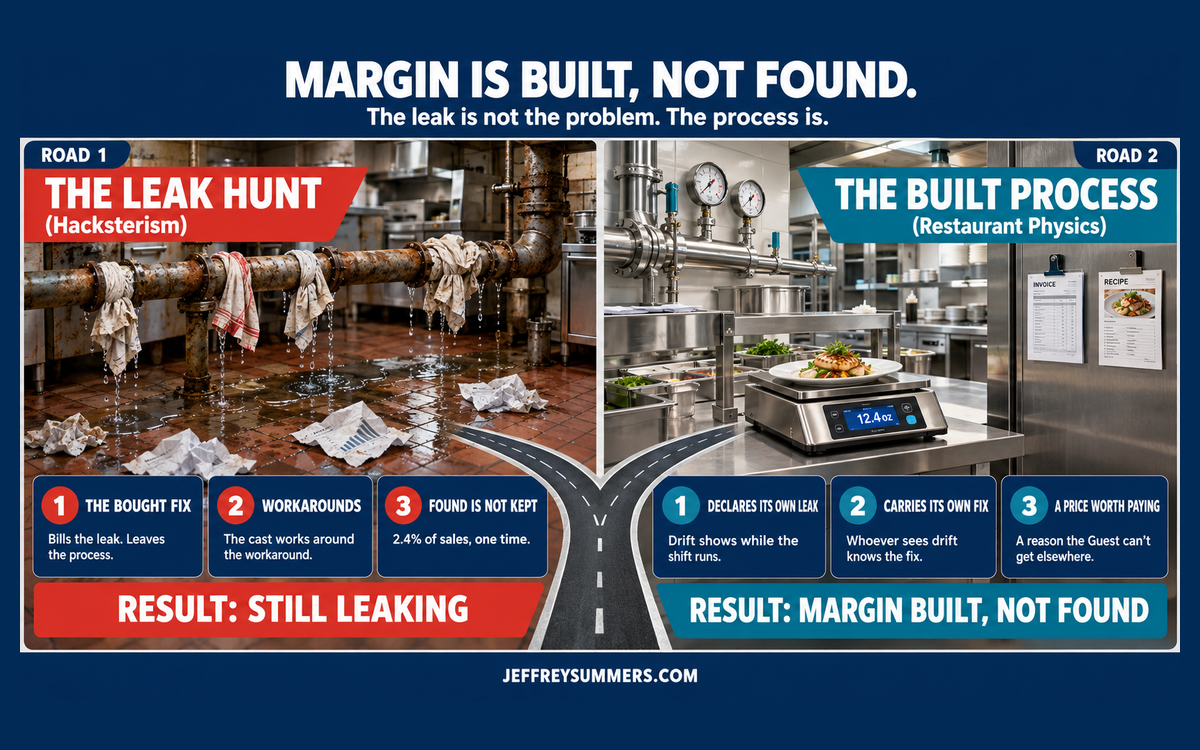
The leak is the most comfortable diagnosis anyone can sell a restaurant operator, because it tells him the pipe is sound and the money is escaping through a hole, and in most restaurants the pipe is what’s broken.
Every ad and every other post in the feed is about operators leaking money. Find the 5 to 8 percent leaking from your kitchen. Plug the leaks in your food cost. Stop the bleeding. The purest version I have heard is a guarantee: the seller will find enough in your leaks to pay his bill, and if he doesn’t, he works for free. That pitch runs on operators whose margins are flat or negative. It is paid for out of margin they already had. It recovers a couple of points of sales, one time. And it leaves every process that produced the leak running exactly the way it ran before he walked in. What is at stake is the only question that matters to that operator, whether his restaurant was built to make money in the first place, and the leak pitch exists to keep him from asking it.
The Guarantee Is A Bet He Cannot Lose
Every restaurant wastes something. Every restaurant has a heavy portion, a stale recipe card, a comp nobody explained, an invoice nobody checked against the card. Promising to find your fee in your leaks is promising to find dust in a kitchen. He is not taking a risk. He is describing the building.
He also grades himself. Found money is whatever his spreadsheet says it is, calculated his way, on his timeline, and he is paid on found. Found is not kept. Nobody comes back in six periods to see whether the portion he tightened is still tight on a busy Saturday, whether the card he updated in October is still right in March, whether the comp he flagged stopped or just moved to a different server. The guarantee is written against the one number he controls.
And you pay him from your own margin. The money he finds was already yours. It was sitting in your operation, leaving through processes you built. At best the engagement breaks even. You hand him the leak he found, you keep the repair, and the process that sprang the leak is still in the building.
Then there is the cap. If his fee is what the leak is worth, the leak was never the problem. The problems that decide whether a restaurant makes money are bigger than his fee, and they are not on his list, because they cannot be found once and invoiced.
Run The Arithmetic
Say food runs 30 percent of sales. He finds the full 8 percent he advertises. Eight percent of a 30 percent line is 2.4 percent of sales. That moves a flat operation to a thin one and a losing operation to a slower loss. It does not move either one to a restaurant that makes money.
And you only find a leak once. Whatever produced the margin you have, a price the operation never earned or costs the volume cannot carry, is still running next month. That is repair, not a fix. It returns the operation to where it was, and where it was is what produced the problem.
Five Leaks, Found Without Looking
Here is the joke, stated plainly. You can find five money leaks in any restaurant the way you find peanut butter on the lid when you open the jar. They are always there. Finding them is not a skill. Take one $18 plate, costed at $5.40, a 30 percent food cost on paper.
-
Protein yield. $3.60 of that $5.40 is protein, costed at purchase price. Protein yields about 75 percent after trim and cooking, so the usable cost is $4.80 and the plate is really $6.60. That is 36.7 percent before anybody plates a thing. Why didn’t the process declare it? Because the card costs protein at what it cost at the back door, and nothing in the costing ever reads yield. Why did it spring? Because nobody built yield into the card.
-
Heavy portions. The recipe says six ounces. On a busy Saturday with nobody checking, it goes out at eight. The protein is now $6.40 and the plate $8.20, 45.6 percent on a dish the card still calls 30. Why didn’t the process declare it? Because nothing at the pass reads weight while the plate is being built. Why did it spring? Because the card assumes somebody checks, and on a busy Saturday nobody does.
-
Supplier price drift. The card built in January is a different number by July, because the invoice moved and the card did not. Why didn’t the process declare it? Because receiving checks the count on the case and never the price against the card. Why did it spring? Because the card and the invoice were never connected to each other in the first place.
-
Comps and discounts. The table that pushed back and got 20 percent off paid $14.40. Against the real plate, that is 45.8 percent. Why didn’t the process declare it? Because the comp came off the check without a conversation and disappeared into the variance. Why did it spring? Because the cast member holding the check at the table was never given the argument for the price.
-
Delivery commission. The platform takes 30 percent of the $18 before food cost is calculated. The operator receives $12.60, and against the real plate that is 52.4 percent. Same dish, same card, still 30 percent. Why didn’t the process declare it? Because the menu was priced for the dining room and nobody ever priced it for the platform. Why did it spring? Because the channel was added and the price was not.
-
Waste and spoilage. 7. Over-ordering. 8. Shorted deliveries. 9. Invoice errors. 10. Recipe cards nobody updated. 11. Over-pouring at the bar. 12. Voids. 13. Theft. 14. The fuel surcharge now sitting on every case.
That is fourteen, and I have not opened the walk-in. The list does not end, because the leaks are not the problem. Run every one of them through the same two questions, why didn’t the process declare it and why did it spring, and every answer lands in the same place. Bad process design. If a process cannot declare a leak on its own and does not carry a fix for it, it is a bad process. Patch the leak and the bad process springs the next one.
Notice how every one of those leaks gets found. After the fact, at period close, when actual food cost comes in over theoretical and somebody goes looking. That is a second design failure sitting on top of the first. The process leaks, and the process cannot see its own leak. The second failure is the one that lets the first run for weeks, and it is the one the leak seller lives on. He is paid for the two things a good process already does, finding the leak and fixing it.
The Word Picks The Fix
Calling it a leak already chose the remedy. A leak means the pipe is fine and there is a hole in it, so you patch the hole. If the operator called it what it is, a process that no longer fits the operation, the remedy would be redesign. The word sends him to [Repairman Syndrome] before he has thought about it.
That is the whole business model. [Repair Work] solves a problem inside the frame the problem lives in and returns the operation to the state it was in before the problem showed up. The leak pitch sells [Repair Work] as a recovery and times it to the moment the leak finally hurts enough to get the operator off the nail. The seller does not need the operator to be wrong about his leaks. He needs the operator to be wrong about his pipe.
Every Fix He Sells Is A Workaround
Look at what actually gets installed. A new count sheet. A portion scale nobody was trained on. A comp code. A second approval on the invoice. A report the kitchen manager is supposed to read on Tuesdays. Not one of them takes the leak out of the process. Every one of them routes around it. The fix is a workaround with a price tag on it.
Then the cast builds their own workarounds around the bought one, because the bought one does not fit the way the shift actually runs. The scale gets moved off the line because it slows the pass. The second approval gets signed at the end of the week in a stack. The comp code becomes the way to make any uncomfortable table go away. Now there are workarounds stacked on workarounds, the leak is still at the bottom of the pile, and the cast is carrying all of it at once in the middle of a shift.
My work has names for both halves of that pile. [The Bandaid Scaffolding] is each bandaid meant to be temporary, accumulating into load-bearing structure that obscures the operation from the operator’s own read. [Complexity Decline] is decay through compounding action, every workaround, every added process, every undocumented exception, until the system can no longer produce the experience it was built to produce. The leak economy is the industry’s largest supplier of both. And the force it installs is [Friction], running from production to service, keeping the cast from delivering what the operation is already capable of delivering.
The Guest pays too. When the leak seller’s target is missed, the easy moves are portion trims, cheaper substitutes, a smaller plate. The Guest reads every one of them. Each one is a withdrawal on the relationship, and enough of them is [Disearned Trust], built one recovered point at a time.
The Newest Leak Hunt Comes With A Label Printer
On September 28, MarginEdge launched SmartPrep, AI-powered prep forecasting with a label printer, dissolvable labels, and QR tracking of on-hands. The CEO’s statement is the leak economy’s new pitch in one line: “Restaurant technology has traditionally focused on helping operators understand what has already happened. What’s transformational about AI is its ability to make sense of enormous complexity and predict what teams should do next.” He closes on the benefit, “Reducing waste.”
Read what the prediction is built from, in the release’s own words: “sales history, purchases, recipes, inventory, shelf life and prep patterns.” Every one of those is what already happened. The forecast is the past projected forward, with seasonality, day of the week, and weather added. It knows only the demand the operation has already had.
Give it the credit it has earned. It is the first thing in this piece that gives one process sight of its own drift, because managers can see where follow-through is slipping while the day is still running. That is the right idea, applied to the smallest leak in the building. It preps the existing menu more precisely, including a menu priced from the wrong end. That is [AI As Amplifier]: the tool magnifies the architecture it walks into. And the hardware, the labels, the forecast, and the data all sit inside one vendor’s platform across more than 13,000 restaurants. That is [Vendor Capture], sold as a waste reduction.
The Diagnostic
Test One — The Price Test. Read the offer. Does it name a single price problem, or only kitchen waste? If every leak on the list lives in the kitchen and none of them lives on the menu, the offer is built to miss the largest thing that decides your margin.
Test Two — The Six-Period Test. Ask how the result is measured. If the answer is his spreadsheet at the end of the engagement, the result is found money. Ask him to be paid on what your P&L shows six periods later. If he will not, he knows the difference between found and kept.
Test Three — The Walk-Away Test. Ask whether the fix holds if he never comes back. If the answer depends on somebody in your building remembering to run his report, the fix is a workaround and the leak is still in the process.
Test Four — The Declaration Test. Ask what his fix changes about the process so that the process declares the next leak on its own, where it happens. If the answer is that he will come back and look again, you are buying a subscription to your own bad design.
Fail two of these and you are buying [Repair Work]. Fail all four and you are buying the next leak hunt too.
The Closer
Margin is built, not found. The leak seller cannot sell you that, because the day an operator understands it, the leak stops being the diagnosis and the pipe becomes the question. Every leak he finds was produced by a process that could not see itself and did not fit the operation, and every fix he installs routes around it and hands the cast one more workaround to carry. Anyone can find five money leaks opening a jar of peanut butter. That is exactly why finding them was never worth paying for.
What You Do Monday Morning
Pull the last four weeks of checks for your top five sellers out of the POS. For each one, write down what the plate should have brought in at menu price, then what it actually brought in after comps, discounts, and delivery commission. While those checks are out, write down who comped what. That is an afternoon’s work, and for most operators it is the first time they see that the menu price is not the price. Then take the biggest gap on the sheet and ask the two questions: why didn’t the process declare it, and why did it spring.
To understand the ideal state, go to Restaurant Physics.
Digging Deeper
Positions on the record:
-
What I Have To Undo Before I Can Fix Anything — https://jeffreysummers.com/what-i-have-to-undo-before-i-can-fix-anything/
-
Margin Is Built, Not Found — https://physics.jeffreysummers.com/margin-is-built-not-found/
-
The Hack Roster: Social Media, Food Cost Consulting, And Culture Workshops All Fail For The Same Reason — https://hacksterism.jeffreysummers.com/the-hack-roster-fix-the-symptom-consulting-layer/
-
The Hack Roster: The Repair Market Runs Because Restaurants Are Multi-Domain Systems Being Sold Single-Domain Fixes — https://hacksterism.jeffreysummers.com/the-hack-roster-the-repair-market-itself/
-
Why Most Restaurant Consulting Makes It Worse — https://jeffreysummers.com/why-most-restaurant-consulting-makes-it-worse/
-
Every Read You Own Has A Date On It — https://physics.jeffreysummers.com/every-read-you-own-has-a-date-on-it/
-
The Night Your Guest Started Keeping Score — https://physics.jeffreysummers.com/the-night-your-guest-started-keeping-score/
Terms used in this piece: Repairman Syndrome, Repair Work, The Bandaid Scaffolding, Complexity Decline, Friction, Disearned Trust, AI As Amplifier, Vendor Capture. Definitions in the Knowledge Base (https://kb.jeffreysummers.com/).
Sources Cited In This Piece
-
GlobeNewswire, September 28, 2026 — MarginEdge launch of SmartPrep; Bo Davis, co-founder and CEO: “Restaurant technology has traditionally focused on helping operators understand what has already happened. What’s transformational about AI is its ability to make sense of enormous complexity and predict what teams should do next,” and “Reducing waste”; inputs listed as “sales history, purchases, recipes, inventory, shelf life and prep patterns”; seasonality, day of the week and expected weather; label printer, dissolvable labels, QR tracking of on-hands; managers can see “where follow-through may be slipping”; more than 13,000 restaurants supported — https://www.globenewswire.com/news-release/2026/09/28/3369921/0/en/marginedge-launches-smartprep-bringing-ai-powered-forecasting-into-the-kitchen.html

1 comment